
8 Tax Reduction Strategies for High Earners

Adaptable Methodologies for a Shifting Tax Landscape

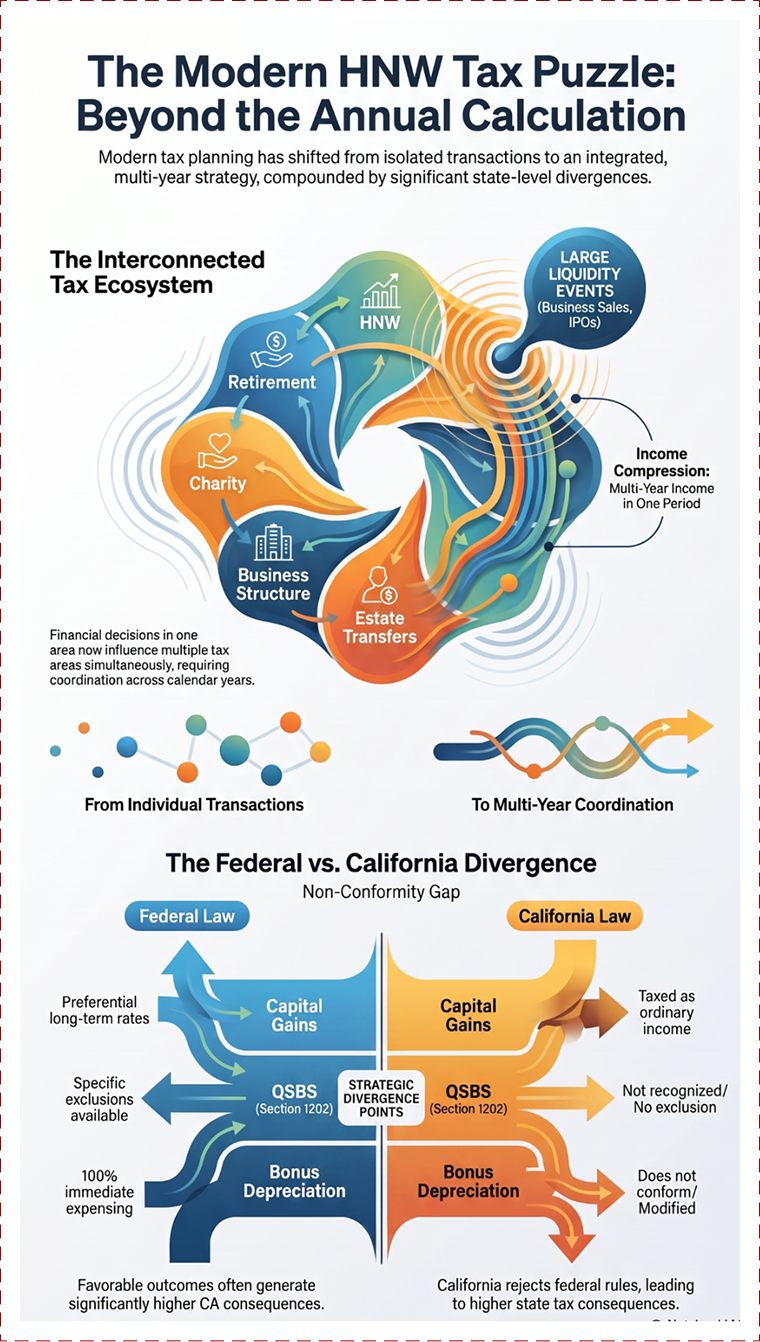
The fiscal landscape of 2026 marks a definitive shift for high-income taxpayers. With the passage of the One Big Beautiful Bill Act (OBBBA) in July 2025, the federal tax code has moved from the temporary "sunset" environment of the last decade into a permanent architecture. While this provides much-needed certainty, it also introduces systemic hurdles—such as new "floors" and "haircuts"—that effectively compress the value of deductions for those in the highest marginal brackets. In California, the environment is further complicated by the state's decision to treat capital gains as ordinary income, reaching rates as high as 13.3%.

A successful retirement and wealth preservation plan requires a detailed approach built on accurate data and realistic assumptions. Because small mistakes can be costly, high earners must look beyond generic advice to understand how their investments and tax obligations interact. The following analysis explores eight sophisticated tax reduction strategies designed for the 2026 fiscal year.

Maximizing Retirement Architecture and the Rothification Shift

Strategy 1: Optimizing 401(k) Contributions and Super Catch-Ups. For 2026, the IRS has significantly increased contribution limits, providing expanded opportunities for tax-deferred growth. The standard 401(k) employee deferral limit has risen to $24,500, and for those aged 50 and older, a catch-up contribution of $8,000 is available. A significant new provision for 2026 is the "super catch-up" of $11,250 for individuals aged 60 to 63, allowing for a total late-career deferral of $35,750. However, high earners must account for the mandatory "Rothification" of catch-up contributions.

Under the SECURE 2.0 Act, if your prior-year FICA wages (the compensation reported for Social Security and Medicare tax purposes) exceeded $150,000, all catch-up contributions must be made on a Roth basis, removing the immediate deduction in exchange for tax-free growth. This SECURE 2.0 provision effectively shifts certain higher-income workers' catch-up contributions from pre-tax to after-tax treatment ("Rothification"), accelerating tax revenue while preserving the retirement savings benefit.

Strategy 2: The Mega Backdoor Roth Architecture. For high earners who have outgrown direct Roth IRA contributions due to income limits, the Mega Backdoor Roth remains the gold standard for maximizing a Roth footprint. By leveraging the $72,000 total defined contribution limit, a participant can contribute up to $47,500 in after-tax (non-Roth) dollars after maximizing their initial $24,500 elective deferral. These after-tax funds are then immediately converted to Roth within the plan or rolled out to a Roth IRA, shielding future growth from taxation. This strategy is particularly effective for self-employed individuals with Solo 401(k) plans, as they maintain complete control over plan design to ensure these conversions are permitted.

8 Tax Reduction Strategies for High Earners
Fig.1: A snapshot of High-Net Worth Tax Planning in 2026.

Strategic Business and Real Estate Deductions

Strategy 3: Permanent Restoration of 100% Bonus Depreciation. Real estate remains a powerful vehicle for wealth preservation in 2026 due to the OBBBA’s permanent restoration of 100% bonus depreciation. This provision allows for the immediate expensing of qualifying property with a useful life of 20 years or less, such as land improvements and certain building components. To fully leverage this, investors should utilize cost segregation studies to reclassify assets into shorter-life asset classes. For a $2,000,000 commercial acquisition, identifying $500,000 in bonus-eligible property allows for a full $500,000 Year 1 write-off, creating a massive non-cash loss that can offset other income. Knowing how to reduce taxable income through these accelerated deductions is central to optimizing near-term cash flow.

Strategy 4: Enhanced Section 179 Expensing for Capital Efficiency. The OBBBA has also increased the Section 179 deduction limit to $2.56 million, providing a robust alternative to bonus depreciation for specific nonresidential improvements. This deduction applies to interior improvements, roofs, and HVAC systems, though it remains subject to net income limitations. Business owners should evaluate Section 179 alongside bonus depreciation to maximize deductions across different asset classes and reduce current liability. Furthermore, the calculation for the Section 163(j) interest expense limitation has reverted to an EBITDA-based calculation, generally increasing the amount of deductible interest in 2026.

Advanced Charitable Giving and Philanthropic Optimization

Strategy 5: Navigating the 0.5% AGI Floor and 35% Benefit Cap. The OBBBA has fundamentally altered the "return on investment" for charitable giving through two new mechanisms: a 0.5% AGI floor and a 35% benefit cap. Beginning in 2026, itemizers can only deduct charitable contributions to the extent they exceed 0.5% of their Adjusted Gross Income. For a taxpayer with an AGI of $2,000,000, the first $10,000 of donations provides no tax relief. Furthermore, the value of itemized deductions for those in the top 37% federal bracket is now capped at 35%. To optimize tax deduction strategies, high earners should consider "bunching" multiple years of donations into a single year to clear the 0.5% floor and exceed the standard deduction threshold simultaneously.

Strategy 6: Leveraging Qualified Charitable Distributions (QCDs). For taxpayers aged 70½ and older, QCDs remain one of the most efficient giving tools available. Because a QCD is transferred directly from an IRA to a qualified charity and is excluded from AGI altogether, it bypasses the 0.5% floor and the 35% deduction cap. For 2026, the QCD limit is indexed for inflation, allowing up to $100,000+ per individual to be removed from their taxable estate while satisfying Required Minimum Distributions. This strategy is particularly effective for high earners who do not need the full amount of their RMD for living expenses and wish to minimize their future tax exposure.

California-Specific Workarounds for Business Owners

Strategy 7: The Pass-Through Entity (PTE) Elective Tax Extension. In California, the Divergence from federal norms remains a primary planning challenge, but business owners can leverage the Senate Bill 132 extension of the PTE elective tax. This program allows S-corporations and partnerships to pay a 9.3% tax at the entity level, generating a federal deduction that bypasses the individual SALT cap. While the federal SALT cap has temporarily risen to $40,000, it still phases back down to $10,000 for high earners with MAGI over $505,000, making the PTE election a critical tool. To the question of paying lower taxes at the state level, SB 132 provides a vital answer through 2030, though new rules apply. Starting in 2026, failing to make the June 15 prepayment no longer disqualifies the election, but it results in a permanent 12.5% reduction of the owner's PTE credit.

Dynamic Portfolio Management and Asset Location

Strategy 8: Aggressive Tax-Loss Harvesting for Ordinary Income Offsets. With combined federal and California rates approaching 40% for top-tier investors, asset location and tax-loss harvesting are essential components of a strategy for how to reduce taxable income for high earners. Tax-loss harvesting involves selling losing investments to offset realized gains, thereby lowering total taxable income for the year. Because California does not provide preferential treatment for long-term holdings and taxes all gains as ordinary income, harvesting losses is particularly impactful for residents as it directly offsets those high state rates. High earners should also consider installment sales for large liquidity events, such as selling a business or rental property, to spread proceeds over multiple years and avoid receiving a lump sum that could push their entire income into a higher marginal bracket.

Ultimately, real answers in wealth preservation come from data, not generic advice. As the OBBBA era begins, the most successful taxpayers will be those who view these complex rules as dynamic variables in a larger year-by-year strategy. By integrating retirement super catch-ups, California PTE workarounds, and accelerated real estate deductions, high earners can build a financial future that is both planned and controlled.

Disclaimer: The information provided is for educational and informational purposes only and should not be construed as personalized investment, tax, or financial planning advice. Every individual’s financial situation is unique, and strategies discussed may not be appropriate for your specific circumstances.
You should consult with a qualified financial advisor, tax professional, or other appropriate professional before implementing any financial strategy.

Investment advisory services are offered through Financial Advisors Network, Inc., a Registered Investment Advisor. Advisory services are provided only to clients under a written agreement and after a thorough review of their individual financial circumstances.
All investments involve risk, including the potential loss of principal. Past performance does not guarantee future results. Any examples, illustrations, or strategies referenced are for informational purposes only and are not intended to represent specific recommendations or guarantees of performance.

Turn Bulletins into Action

Stay informed—then come in for a free consultation and see how the updates apply to your financial life.

How did you find us?
Thank you! Your submission has been received!
Oops! Something went wrong while submitting the form.