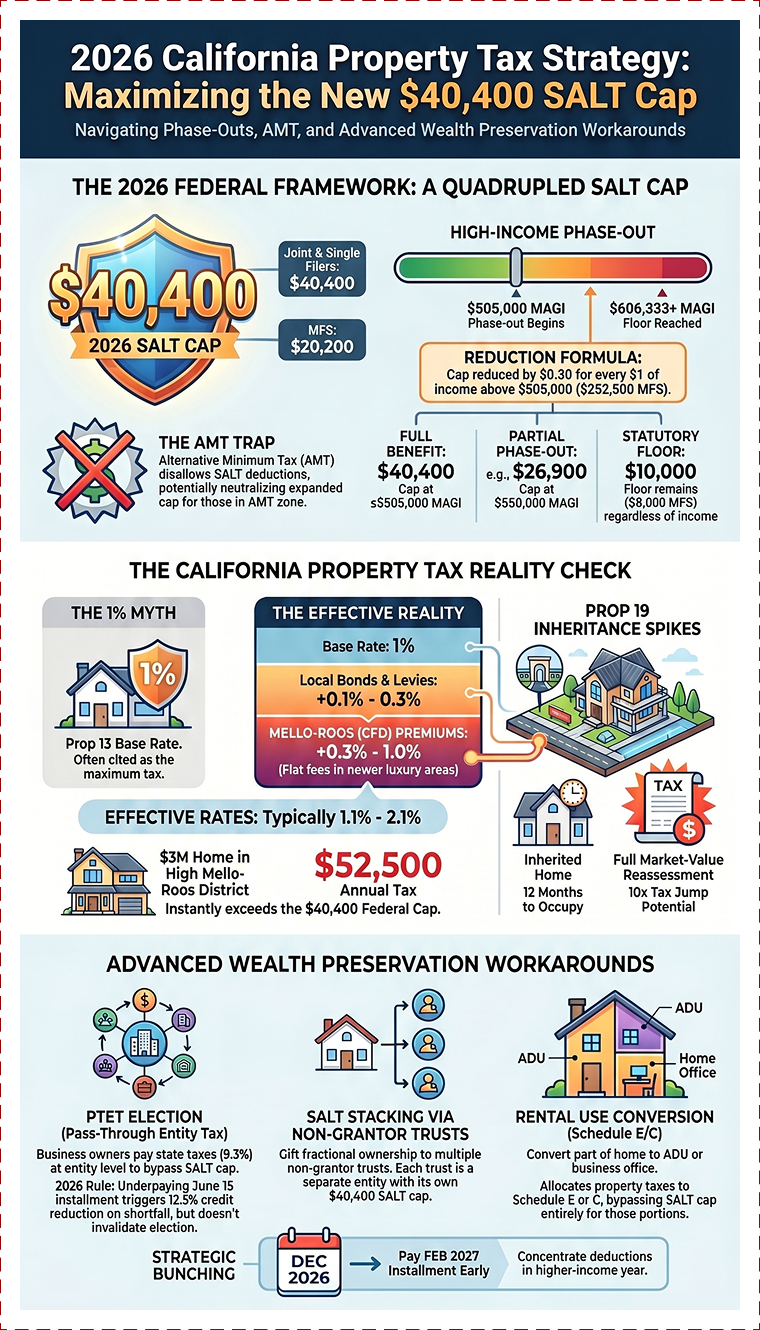
The 2026 SALT Framework and Individual Limitations
Under the current federal framework, real estate taxes are deductible as part of the broader State and Local Tax (SALT) deduction. This deduction allows taxpayers who itemize on Schedule A to subtract eligible property taxes, personal property taxes, and either state income or general sales taxes from their federal taxable income.
For the 2026 tax year, the standard deduction has been indexed to $32,200 for married couples filing jointly and $16,100 for single filers. Consequently, a property tax deduction on federal taxes only yields a benefit when total itemized deductions exceed these thresholds.
The most significant shift for 2026 is the quadrupling of the individual SALT cap to $40,400, up from the restrictive $10,000 limit imposed by previous legislation. However, this expanded ceiling is subject to a steep, marginal phase-out mechanism targeting high earners. For the 2026 tax year, the phase-out threshold begins at a modified adjusted gross income (MAGI) of $505,000 for single and joint filers. For every dollar of MAGI exceeding this limit, the allowable SALT cap is reduced by 30 cents.
Data modeling shows that any taxpayer with a 2026 MAGI equal to or exceeding $606,333 will find their SALT deduction cap fully reduced to a statutory floor of $10,000. This math dictates that ultra-high-income households often derive no additional benefit from the expanded 2026 cap without advanced structural planning.