
High Income Tax Planning (2026)

High Net Worth Tax Strategies for Effective Retirement Planning

A strong financial strategy starts with a clear plan grounded in accurate data and realistic assumptions. For high-net-worth individuals, retirement planning is becoming more complex, especially as both federal and state laws shift — and not always in sync — creating new tax challenges.

Indeed, taxes are often the most underestimated expense in long-term projections. Small mistakes with large sums can be costly, and in 2026, effective tax strategies for high earners start with recognizing that tax is not a one-time calculation but a year-by-year process that evolves with your situation.

The Federal Framework: Permanent Brackets and Inflation Adjustments

The One Big Beautiful Bill Act (OBBBA), enacted in July 2025, created a more predictable federal tax baseline by making permanent the individual tax rates first introduced under the 2017 Tax Cuts and Jobs Act. For 2026, the Internal Revenue Service continues to use seven brackets: 10%, 12%, 22%, 24%, 32%, 35%, and 37%.

So tracking bracket thresholds precisely remains essential. The top 37% marginal rate applies to income above $640,600 for single filers and $768,700 for married couples filing jointly. The OBBBA also introduced a nuanced inflation adjustment system for 2026, with a 4% increase applied to the lowest two brackets and a smaller 2.3% adjustment applied to higher-income brackets.

The standard deduction rises to $16,100 for single filers and $32,200 for joint filers. While the personal exemption remains at $0, high-income planning must factor in the temporary “Senior Bonus Deduction.” Taxpayers age 65 and older can claim an additional $6,000 deduction ($12,000 for couples), but the benefit phases out quickly. It is reduced by 6% for every dollar of modified adjusted gross income (MAGI) above $75,000 for individuals and $150,000 for couples, reaching zero at $175,000 and $250,000, respectively.
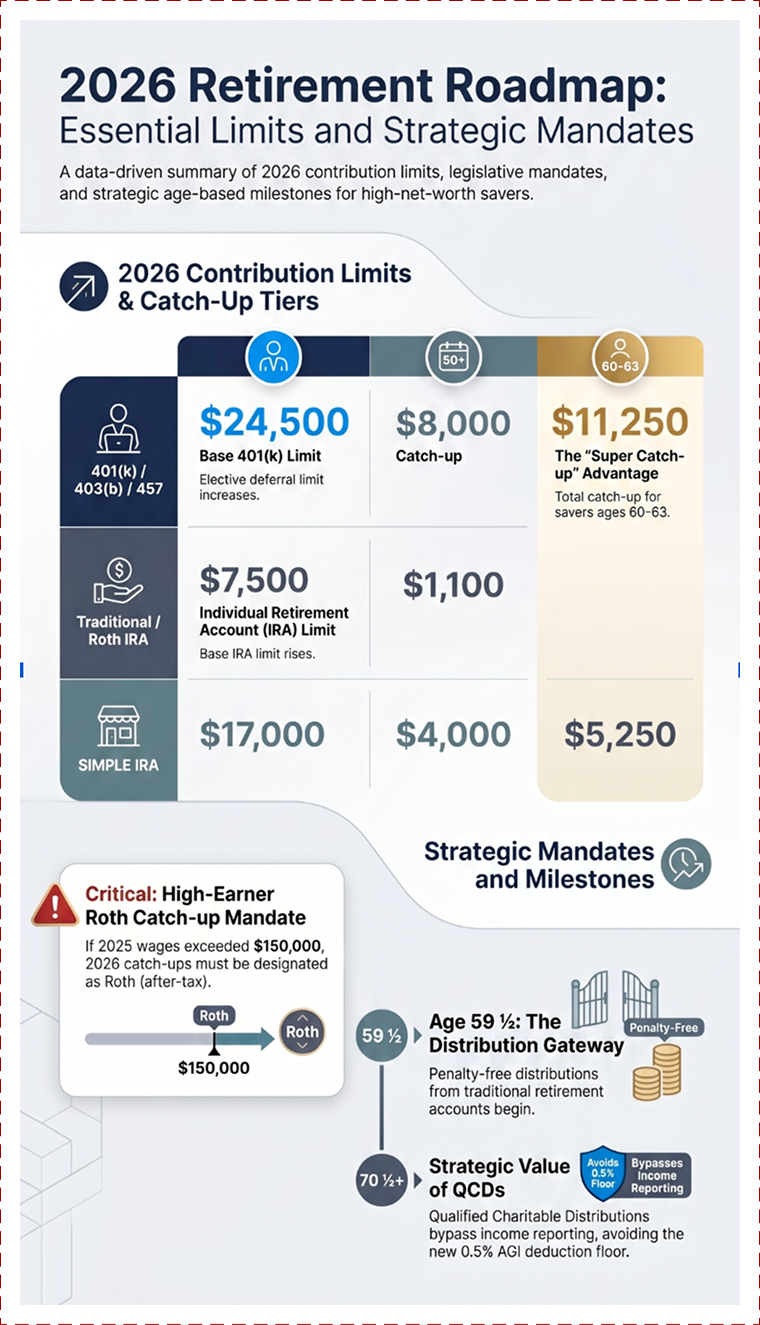

Strategic Navigation of Retirement Accounts

A central component of high net worth tax strategies involves the management of qualified retirement plans. Contributions to a traditional 401(k) are pre-tax, meaning they reduce your annual taxable income. Therefore, 401k contributions are tax deductible (or rather, excluded from gross income) in the year they are made.

However, it is important to understand that a 401(k) is taxable upon withdrawal. The tax rate on 401(k) distributions is generally your ordinary income tax rate in the year the funds are received. Furthermore, high-income earners must consider whether employer contributions to 401(k)s are taxed. Generally, employer-matching or profit-sharing contributions are not taxed when contributed but are taxable as ordinary income when you receive a distribution in retirement.

When planning cash flow, you must know at what age you can withdraw from 401(k) without penalty. The standard distribution age for penalty-free withdrawals is 59 ½. If you need to know how to withdraw money from a 401(k) before retirement, be aware that most early distributions are subject to a 10% penalty in addition to ordinary income taxes. For those contemplating early retirement, while you can take money out at age 62 without a penalty, the full amount remains subject to 401(k) disbursement taxes, which could push you into a higher tax bracket.

Compliance with the SECURE 2.0 Act's "Roth Catch-Up" mandate is another essential consideration. Beginning in 2026, participants whose Social Security wages in 2025 exceeded $150,000 are mandated to make all catch-up contributions as Roth (after-tax) rather than pre-tax. This prevents high earners from using catch-up contributions to reduce their immediate taxable income.

High Income Tax Planning (2026)

Fig.1: A well-executed tax plan can help your savings go further in retirement.

The California Complexity: Highest Marginal Rates in the U.S.

For California residents, state taxes add another layer of complexity. While statutory rates range from 1% to 12.3%, the effective marginal rate often reaches 14.4% or higher for top earners.

This combined rate is driven by three components:

  • Statutory Top Bracket: 12.3% on income above $721,320 (single) or $1,442,640 (joint).
  • Behavioral Health Services Tax: A 1% surcharge on income exceeding $1,000,000.
  • State Disability Insurance (SDI): With the wage cap removed under Senate Bill 951, a 1.3% tax applies to all wage income in 2026.

California taxes capital gains as ordinary income, meaning there is no preferential treatment for long-term investments. The state also diverges from federal law on key provisions, including the 20% pass-through deduction (Section 199A) and bonus depreciation.

The SALT Cap Phasedown: A "Stealth" Offset

One of the more subtle but impactful changes in 2026 is the restructuring of itemized deductions. The OBBBA increases the federal State and Local Tax (SALT) deduction cap to $40,400. However, this benefit is gradually reduced for higher-income households.

When MAGI exceeds $505,000, the SALT cap is reduced by 30% of the excess income until it returns to $10,000. This creates a narrow income band between $505,000 and $606,333 where each additional dollar not only increases taxes owed but also reduces a valuable deduction, effectively raising the marginal tax rate in that range.

To address SALT limitations, California business owners can consider the Pass-Through Entity Tax (PTET). Senate Bill 132 extends this strategy through December 31, 2030. It allows eligible S corporations and partnerships to pay state income tax at the entity level at a 9.3% rate.

These payments are treated as deductible business expenses at the federal level, reducing the owner’s K-1 income before the SALT limitation applies. However, this strategy requires careful analysis. Because PTET reduces federal income, it also lowers the base used to calculate the Qualified Business Income (QBI) deduction. The net benefit depends on balancing federal tax savings against the reduced QBI deduction.

Philanthropy Constraints: Floors and Caps

Charitable giving rules became more restrictive in 2026. Taxpayers who itemize must first exceed a 0.5% threshold before deductions apply. For example, a household with $1,000,000 in AGI must contribute $5,000 before receiving any tax benefit.

In addition, taxpayers in the 37% bracket face a limitation where deductions are effectively valued at 35 cents per dollar. This creates a 2% gap, as income is taxed at 37% but deductions offset only 35%. Qualified Charitable Distributions (QCDs) from IRAs for individuals over age 70½ remain an important strategy because they reduce taxable income directly and are not subject to these limitations.

Investment Planning and QSBS Nuances

The OBBBA expands the benefits of Qualified Small Business Stock (QSBS), introducing a tiered exclusion structure based on holding periods of three to five years. For stock issued after July 4, 2025, the exclusion limit increases to $15 million per issuer, and the eligibility threshold rises to $75 million in gross assets.

However, California does not conform to QSBS rules under Section 1202. This means a taxpayer could exclude up to $15 million in gains at the federal level while still owing approximately $2 million in California taxes on the same transaction.

Legacy Planning and Wealth Transfer Strategies

Estate and gift tax exemptions remain historically high, reaching $15 million per individual and $30 million for married couples in 2026. The annual gift exclusion remains $19,000 per recipient.

Beyond exemption planning, high-net-worth individuals may benefit from evaluating broader legacy strategies, including lifetime gifting approaches, trust structures, charitable planning, and the coordination of beneficiary designations across retirement and investment accounts. These strategies can help align wealth transfer decisions with family objectives while maximizing flexibility in an ever-changing tax environment.

The 2026 tax environment reflects a shift toward a more stable yet increasingly complex framework. Avoiding surprises requires ongoing attention and a clear understanding of how personal financial data interacts with evolving tax rules. Reliable outcomes depend on precise inputs, and proactive, year-round planning remains essential for navigating a high-income tax landscape.

Disclaimer: The information provided is for educational and informational purposes only and should not be construed as personalized investment, tax, or financial planning advice. Every individual’s financial situation is unique, and strategies discussed may not be appropriate for your specific circumstances.
You should consult with a qualified financial advisor, tax professional, or other appropriate professional before implementing any financial strategy.

Investment advisory services are offered through Financial Advisors Network, Inc., a Registered Investment Advisor. Advisory services are provided only to clients under a written agreement and after a thorough review of their individual financial circumstances.
All investments involve risk, including the potential loss of principal. Past performance does not guarantee future results. Any examples, illustrations, or strategies referenced are for informational purposes only and are not intended to represent specific recommendations or guarantees of performance.

Turn Bulletins into Action

Stay informed—then come in for a free consultation and see how the updates apply to your financial life.

How did you find us?
Thank you! Your submission has been received!
Oops! Something went wrong while submitting the form.