
Understanding Self-Employment Tax

What You Need to Know About Tax on Self-Employment Income

For high-net-worth individuals (HNWIs) in 2026, the transition into self-employment or the ongoing management of a successful enterprise represents a shift into a world of heightened fiscal complexity. At Financial Advisors Network, we know that small mistakes with large amounts of money are expensive, and in the current tax landscape, real answers regarding your liability must come from data, not generic advice.

A successful financial strategy is a year-by-year plan built on accurate data and realistic assumptions. This guide details the structural shifts in 2026 taxation to help you avoid unpleasant surprises and manage your self-employment income with precision.

The Federal Framework: SECA Mechanics and the 2026 Thresholds

The foundational architecture of your tax obligation is governed by the Self-Employment Contributions Act (SECA). The federal self-employment tax is designed to ensure that those working for themselves contribute to Social Security and Medicare at the same aggregate rate as the combined contribution of an employer and employee.

For 2026, the self-employment tax rate is established at 15.3% of net earnings. However, it is vital to understand that the IRS does not assess this tax on 100% of your gross profit. Instead, to create parity with traditional employees, the self-employment tax percentage is calculated on 92.35% of net earnings.

This total rate is bifurcated into two primary components:

  • Social Security (OASDI): Assessed at 12.4%. For 2026, the Social Security wage base—the maximum amount of self-employed income subject to this component—has increased to $184,500.
  • Medicare (HI): Assessed at 2.9%. Unlike Social Security, Medicare has no income ceiling; every dollar of net profit is subject to this tax.

For HNWIs, a secondary threshold exists: an Additional Medicare Tax of 0.9% is triggered when earned income exceeds $200,000 for single filers or $250,000 for married couples filing jointly. Because there is no employer-equivalent match for this surtax, you bear the full 3.8% Medicare tax on high-tier earnings.
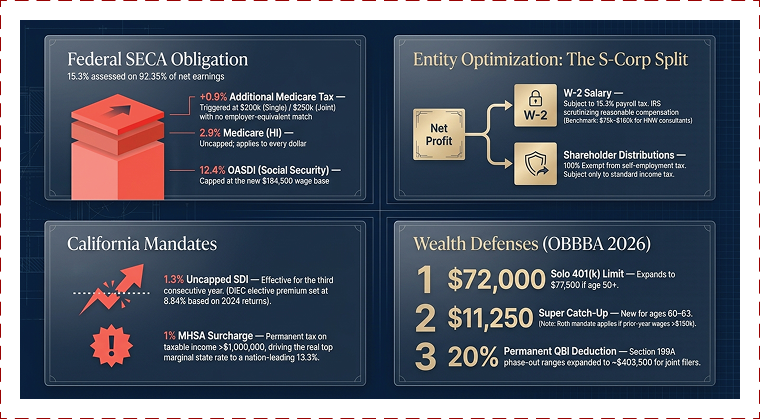

Understanding Self-Employment Tax
Fig.1: The essentials of self-employment tax strategy.

California’s "Uncapped" Mandates and Surcharges

For families establishing residency in California, federal self-employment tax is merely the first layer of obligation. The state’s 2026 approach is characterized by aggressive, uncapped surcharges that have no federal equivalent.

The most profound shift is the removal of the taxable wage ceiling for State Disability Insurance (SDI). Effective for the third consecutive year in 2026, all wages and covered self-employment earnings are subject to the SDI tax at a rate of 1.3%, up from 1.2% in 2025. For a professional earning $1,000,000 in net profit, this functions as a flat $13,000 surtax.

While traditional employees have mandatory SDI withholding, self-employed individuals must elect to participate through the Disability Insurance Elective Coverage (DIEC) program. For 2026, the DIEC premium rate is set at 8.84% of net profit, based on the profit reported on your 2024 tax return. Additionally, those with taxable income exceeding $1,000,000 face a permanent 1% surcharge under the Mental Health Services Act (MHSA), bringing the real top marginal rate to 13.3%—the highest in the nation.

Strategic Entity Selection: The S-Corp "Split"

When comparing employed and self-employed tax treatments, the choice of business structure is the single most important factor in determining your total burden. Transitioning from a sole proprietorship to an S-Corporation (S-Corp) is a primary strategy to mitigate Social Security and Medicare taxes.

The S-Corp advantage lies in the ability to bifurcate income into a W-2 salary and shareholder distributions. Only the W-2 salary is subject to the 15.3% payroll tax. Distributions are subject to standard income tax but remain entirely exempt from the self-employment tax.

Consider a business generating $250,000 in net profit. As a sole proprietor, the entire amount is subject to SE tax. By electing S-Corp status and paying a "reasonable" salary of $100,000, the owner pays payroll taxes only on that portion. In 2026, the IRS is utilizing advanced data matching to flag S-Corps with artificially low salaries, making it vital that your compensation reflects industry benchmarks—often $75,000 to $160,000 for HNW consultants.

Retirement Optimization and OBBBA Maturation

For self-employed individuals aged 50 and older, paying taxes is more than a cost; it is an investment in your future Primary Insurance Amount (PIA). High earnings in late-career self-employment can "bump" lower-earning years off your 35-year Social Security record, ensuring you receive the maximum possible benefit.

Furthermore, the One Big Beautiful Bill Act (OBBBA) has codified several advantages for 2026:

  • Solo 401(k) Limits: The total contribution limit has increased to $72,000 ($77,500 if age 50+).
  • Super Catch-Up: For the first time in 2026, a "super catch-up" of $11,250 is available for those aged 60–63.
  • Roth Mandate: If prior-year wages exceeded $150,000, all catch-up contributions must be made on a Roth (after-tax) basis starting in 2026.
  • Permanent QBI Deduction: The Section 199A deduction remains a permanent fixture, allowing a 20% write-off on pass-through income, with 2026 phase-out ranges expanded to approximately $403,500 for joint filers

Compliance: How Do I Pay Tax Self-Employed?

The question of how to pay self-employed taxes is answered through a rigorous quarterly estimated payment schedule. Because you do not have taxes automatically withheld, you must use Form 1040-ES to calculate and remit payments for each of the four periods: April 15, June 15, September 15, and January 15.

To avoid underpayment penalties, you must meet 'safe harbor' thresholds—generally 110% of your prior year's liability for high earners. We also emphasize utilizing Form 7206 to claim the self-employed health insurance deduction, which allows you to deduct 100% of premiums for health, dental, and vision insurance for you and your family as an "above-the-line" adjustment to your AGI.

At Financial Advisors Network, we believe in showing the data to earn your trust. Navigating self-employment tax brackets and these technical intersections requires time, knowledge, and passion. The right strategy depends on your specific financial situation, and precision today ensures a predictable outcome for your future.

Disclaimer: The information provided is for educational and informational purposes only and should not be construed as personalized investment, tax, or financial planning advice. Every individual’s financial situation is unique, and strategies discussed may not be appropriate for your specific circumstances.
You should consult with a qualified financial advisor, tax professional, or other appropriate professional before implementing any financial strategy.

Investment advisory services are offered through Financial Advisors Network, Inc., a Registered Investment Advisor. Advisory services are provided only to clients under a written agreement and after a thorough review of their individual financial circumstances.
All investments involve risk, including the potential loss of principal. Past performance does not guarantee future results. Any examples, illustrations, or strategies referenced are for informational purposes only and are not intended to represent specific recommendations or guarantees of performance.

Turn Bulletins into Action

Stay informed—then come in for a free consultation and see how the updates apply to your financial life.

How did you find us?
Thank you! Your submission has been received!
Oops! Something went wrong while submitting the form.