
End of Year Tax Tips

Year-End Tax Strategies for High Net Worth Individuals in California

For high-net-worth individuals, year-end tax planning in 2026 means navigating inflation-adjusted thresholds, timing income events, and managing exposure across federal and California state systems. While statutory federal rates remain structurally stable, the interaction between capital gains realization, executive compensation, business liquidity events, and concentrated asset positions continues to create significant variance in effective tax outcomes.

California adds additional complexity due to its high marginal income tax rates and the concentration of wealth in illiquid assets such as real estate and private equity holdings. As a result, optimization in 2026 is primarily about timing, classification, and coordination across tax regimes, rather than relying on headline rate changes.

Federal Income and Capital Gains Positioning in 2026

At the federal level, the top ordinary income tax rate remains 37%, and continues to apply only once income exceeds high six-figure thresholds that are adjusted periodically for inflation. For high-net-worth households, the more relevant planning issue is often not the top rate itself, but the compression effect between ordinary income and capital gains exposure, particularly in years where liquidity events occur.

Long-term capital gains retain preferential treatment under the 0%, 15%, and 20% structure. Even in 2026, this preferential framework remains a central driver of realization strategy for investors with appreciated equities, carried interests, or concentrated founder stock positions. The key planning consideration is that large one-time realizations can quickly push taxpayers into the top capital gains bracket and potentially trigger additional investment-related surtaxes depending on total income composition.

Because federal thresholds are inflation-adjusted annually, taxpayers with volatile income—such as those selling businesses or exercising large equity positions—often benefit from income smoothing strategies across calendar years rather than clustering gains into a single tax period.
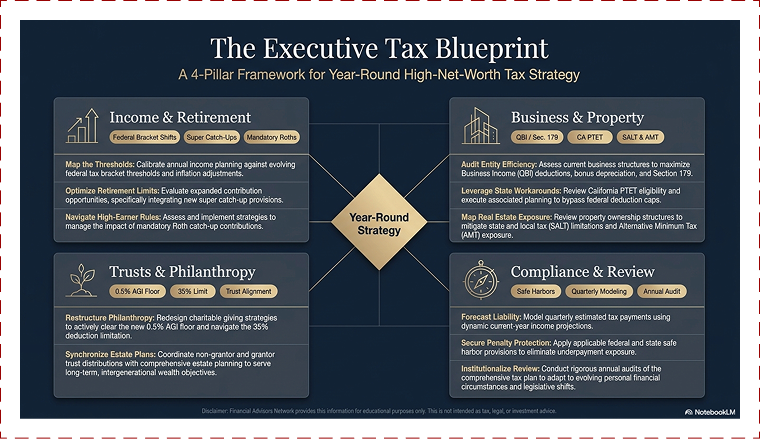

End of Year Tax Tips
Fig.1: We’ve broken down the end-of-year tax planning checklist into four key pillars, here.

Estate and Wealth Transfer Planning Under Sunset Uncertainty

One of the most consequential planning variables in 2026 is the status of the federal estate and gift tax exemption, which remains elevated in 2026 at approximately $15 million per individual (indexed for inflation). This continues to shelter a significant portion of high-net-worth estates from federal transfer taxation, but it also reinforces a key planning dynamic: concentration risk above the exemption threshold.

For families approaching or exceeding this level, estate planning is increasingly focused on structure rather than exemption usage alone. Trust design, valuation techniques for closely held businesses, and lifetime gifting strategies remain central tools.

California does not impose a state-level estate or inheritance tax, which simplifies one dimension of planning. However, because many California residents hold highly appreciated assets—particularly real estate and private equity stakes—the federal system remains the dominant driver of estate exposure. This makes timing of transfers, not just their size, a key variable in long-term planning.

California Tax Environment: High Marginal Rates and Liquidity Timing

California remains one of the highest marginal income tax jurisdictions in the United States, with top rates exceeding 13% for high earners. Unlike federal tax law, California does not provide preferential treatment for long-term capital gains—meaning gains are generally taxed as ordinary income at the state level.

This structural difference has a direct impact on year-end planning behavior. High-net-worth, often self-employed, taxpayers in California often face a dual optimization problem:

  • Minimizing federal capital gains rates through timing and classification
  • Avoiding state-level acceleration of income into peak marginal brackets

This is especially relevant for liquidity events such as IPO lockup expirations, private equity exits, or concentrated stock diversification. In many cases, the decision is not whether to realize gains, but how to distribute them across tax years and legal structures to reduce marginal stacking effects.

Additionally, California residency rules remain a critical audit focus area, particularly for individuals with multi-state or partial-year domicile exposure. Proper documentation of residency intent and activity patterns can materially affect state tax outcomes in high-value realization years.

As the calendar year closes, high-net-worth taxpayers benefit most from coordinated, portfolio-wide tax planning rather than isolated tactics. The most important constraint in 2026 is not the availability of strategies, but the interaction between them. High-income taxpayers frequently experience diminishing returns when strategies are executed independently rather than integrated across income, estate, and state tax considerations.

Disclaimer: The information provided is for educational and informational purposes only and should not be construed as personalized investment, tax, or financial planning advice. Every individual’s financial situation is unique, and strategies discussed may not be appropriate for your specific circumstances.
You should consult with a qualified financial advisor, tax professional, or other appropriate professional before implementing any financial strategy.

Investment advisory services are offered through Financial Advisors Network, Inc., a Registered Investment Advisor. Advisory services are provided only to clients under a written agreement and after a thorough review of their individual financial circumstances.
All investments involve risk, including the potential loss of principal. Past performance does not guarantee future results. Any examples, illustrations, or strategies referenced are for informational purposes only and are not intended to represent specific recommendations or guarantees of performance.

Turn Bulletins into Action

Stay informed—then come in for a free consultation and see how the updates apply to your financial life.

How did you find us?
Thank you! Your submission has been received!
Oops! Something went wrong while submitting the form.