
What Happens to Your 401(k) When You Leave a Job?

The 2026 Landscape for Exiting Professionals

Knowing what happens to your 401(k) when you leave employment is an essential part of retirement planning. The choices you make have different consequences. Understanding the available options helps you avoid unnecessary fees or taxes and ensures your retirement savings stay invested and aligned with your long-term financial goals. Let’s take a look at what can happen.

The four main options for your 401(k)

When you leave a job, you usually have four main choices for what to do with your 401(k):

  1. Leave it in your old employer’s plan – If the plan allows it, you can keep the money there and let it continue growing with the existing investments.
  2. Roll it over into your new employer’s 401(k) – This moves the money into your new workplace retirement plan so all your savings are in one place.
  3. Roll it over into an Individual Retirement Account (IRA) – This often gives you more investment choices and control over your retirement funds.
  4. Cash it out – You withdraw the money, but this usually means paying income taxes and, if you’re under age 59½, a 10% early withdrawal penalty, which can significantly reduce your savings.

Each option affects taxes, investment options, and long-term retirement growth, so choosing carefully helps protect the money you’ve saved.
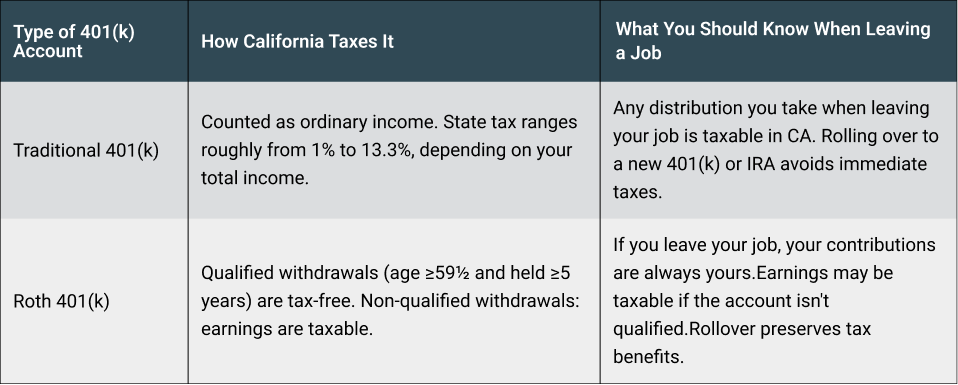

Mandatory Distributions and the $7,000 Threshold

One of the first things to understand is what happens to a 401(k) with a small account balance. Under current statutory limits effective for distributions on or after January 1, 2024, plan sponsors can execute "mandatory cash-outs" for vested balances at or below $7,000.

A vested balance is the portion of your 401(k) that you fully own and are entitled to keep, even if you leave your job. Your own contributions to the plan are always 100% vested, meaning they belong to you immediately. However, employer contributions may follow a vesting schedule, which requires you to work for the company for a certain number of years before you gain full ownership of those funds.

You should meticulously review your 401(k) standing relative to "vesting cliffs," as leaving prior to full vesting can result in you forfeiting significant employer contributions.

The treatment of vested assets is determined by specific balance tiers:

  • Vested balances < $1,000: The plan sponsor can issue a direct payment via check. A default IRA is not required for this tier.
  • Vested balances between $1,000 and $7,000: If no election is made, assets are moved to a "Safe Harbor" Automatic Rollover IRA. These funds are typically held in cash positions, which introduces a significant inflation risk if the assets are not promptly reinvested.
  • Vested balances > $7,000: The plan sponsor cannot distribute these funds without the explicit consent of the exiting professional.
What Happens to Your 401(k) When You Leave a Job?

Rollover Strategies and Rule of 55 Exemptions

It’s also essential to weigh the benefits of consolidated management over investment flexibility.

  • Option 1: The New Employer Plan: Consolidating into a new workplace 401(k) simplifies administration and can lower institutional fees.
  • Option 2: The Rollover IRA: This is often the preferred vehicle for high-net-worth individuals due to its "open architecture". Unlike the limited investment menus of workplace plans, a Rollover IRA allows for a wider range of sophisticated assets, including individual stocks, ETFs, and specialized investment vehicles.

When you leave a job, you can move your 401(k) to a new plan or an IRA in two ways. A direct rollover sends the money straight from your old plan to the new one. This is the simplest option because no taxes are taken out and there’s no time pressure. An indirect rollover gives you a check for the balance. You then have 60 days to deposit the full amount into a new retirement account, or the money is treated as taxable income. Plus, the IRS requires 20% of the check to be withheld for taxes, which you’ll need to make up when redepositing.

If you have an outstanding 401(k) loan when you leave your job, you usually have to pay it back within 60–90 days. If you don’t, the unpaid amount is considered a taxable distribution and could also trigger the 10% early withdrawal penalty if you’re under 59½.

Leaving a job doesn’t have to mean leaving your retirement savings behind. Understanding your 401(k) options—whether it’s rolling over to a new plan, consolidating into an IRA, or knowing when small balances might move automatically—gives you control over your financial future. Taking a moment to make informed decisions now can protect your savings, reduce taxes, and keep your retirement on track.

Disclaimer: The information provided is for educational and informational purposes only and should not be construed as personalized investment, tax, or financial planning advice. Every individual’s financial situation is unique, and strategies discussed may not be appropriate for your specific circumstances.

You should consult with a qualified financial advisor, tax professional, or other appropriate professional before implementing any financial strategy.

Investment advisory services are offered through Financial Advisors Network, Inc., a Registered Investment Advisor. Advisory services are provided only to clients under a written agreement and after a thorough review of their individual financial circumstances.

All investments involve risk, including the potential loss of principal. Past performance does not guarantee future results. Any examples, illustrations, or strategies referenced are for informational purposes only and are not intended to represent specific recommendations or guarantees of performance.

Investing in FTDs involves unique risks, including possible loss of principal. Funds may be idle in cash before and/or between FTD opportunities. Taxes will differ depending upon the type of funds used (taxable tax-deferred, or tax-free). There is no assurance that tht techniques and strategies discussed are suitable for all investors or will yield positive outcomes.

Every FTD investment opportunity is comprised of multiple investors. Not all clients are considered qualified. All FAN clients that invest in FTDs will be required to attend or view a recording of a FTD informational session and sign our Millennium Trust Company and First Trust Deed Investments ADV Disclosure Addendum as well as complete investment paperwork through Macoy. If clients decide to participate, they will continue to pay their household’s FAN’s advisory fee on the amount of the FTD investment as agreed upon in your FAN Wrap Fee Agreement. More information regarding the unique risks of FTD investments can be found in our SEC ADV Firm Brochure.

Turn Bulletins into Action

Stay informed—then come in for a free consultation and see how the updates apply to your financial life.

How did you find us?
Thank you! Your submission has been received!
Oops! Something went wrong while submitting the form.