The Ultimate Retirement Checklist for High‑Net‑Worth Americans

How to start retirement process essentials

For Americans over 50—especially those with significant assets—preparing for retirement is a disciplined, strategic transition rooted in data and structured planning.

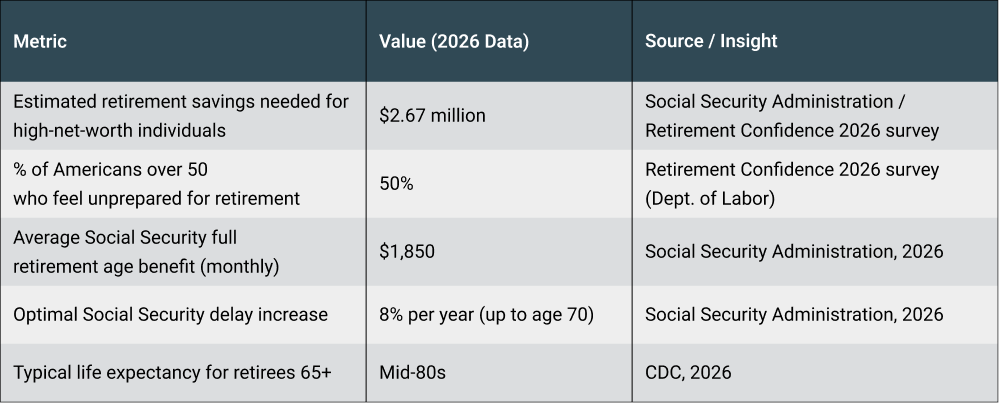
Many surveys show even affluent individuals express concern about retirement readiness, including reports that half of all Americans feel unprepared to live comfortably in retirement, and high‑net‑worth individuals estimate needing roughly $2.67 million to retire worry‑free.

So a robust retirement checklist that integrates financial, healthcare, legal, and lifestyle planning is essential. Here’s a comprehensive framework that forms your pre-retirement checklist and guides the retirement process.

Financial Assessment and Income Strategy

Before entering the retirement phase, the first step in any retirement planning checklist is a frank assessment of current assets and liabilities. For high‑net‑worth individuals, this typically includes:

  • Total investable assets (brokerage accounts, 401(k)s, IRAs, Roth accounts).
  • Real estate equity, including primary residence and investment properties (often overlooked in planning).
  • Business interests and alternative investments (private equity, art, collectibles).
  • Liabilities (mortgages, lines of credit, outstanding business debt).
  • Cash and liquidity position, which will determine flexibility in retirement.

The Federal Reserve’s most recent Survey of Consumer Finances shows that while median net worth rises with age, significant wealth disparities remain; even among those aged 55–64, many carry mortgage debt and lack adequate retirement savings.

With this baseline, your retirement process moves into withdrawal and income planning. This involves a diversified income pathway integrating Social Security, pensions, annuities, and investment distributions. A defined withdrawal ladder should determine sequence, timing, and tax implications of fund distributions. Stress‑testing for market downturns early in retirement mitigates sequence-of-returns risk. High‑net‑worth households often benefit from cash‑flow simulations representing decades of withdrawals under multiple market scenarios.

Social Security optimization is another critical lever: claiming early at age 62 reduces monthly benefits, while delaying until age 70 boosts benefits up to 8% per year. Spousal and survivor benefits, coordinated with your withdrawal strategy, further enhance tax efficiency and lifetime income.

Healthcare and Risk Management

Healthcare represents one of the most significant and unpredictable retirement expenses. Medicare coverage begins at age 65, but early retirees must plan for interim coverage.

Your pre-retirement checklist must include:

  • Estimating Medicare premiums and supplemental coverage costs.
  • Projecting long‑term care insurance, or alternatives if traditional LTC insurance isn’t viable.
  • Accounting for out-of-pocket costs and inflation in medical spending.

Studies show older cohorts are living longer (often into their mid‑80s and beyond), emphasizing the importance of practical healthcare cost forecasts.

Debt management and major expenses are also part of risk management. A strong retirement checklist should include paying off high‑interest debt, finalizing major planned expenses like home renovations or children’s education, and reviewing property tax relief or senior benefits. In high-cost states like California, careful property and tax planning can materially affect retirement sustainability.

The Ultimate Retirement Checklist for High‑Net‑Worth Americans

Estimated retirement savings needed vs. actual preparedness.

Estate, Legacy, and Tax Planning

For high‑net‑worth individuals, wealth transfer mechanics are as critical as income planning. Your pre-retirement checklist should include:

  • Up-to-date estate documents (wills, trusts, powers of attorney).
  • A tax-efficient estate strategy to minimize federal and state estate taxes.
  • Beneficiary review on all accounts to ensure alignment with your legacy intentions.
  • Charitable giving strategies (e.g., donor-advised funds).

Cohesive tax planning extends into retirement, accounting for different state regimes and future liabilities. For many affluent retirees, these strategies integrate with Social Security timing, withdrawals, and liquidity management, ensuring both financial efficiency and long-term wealth preservation.

Lifestyle Vision and Ongoing Review

Finally, the human element of the retirement process must not be overlooked. Your checklist should address:

  • A clear vision of your daily life—hobbies, travel, part-time work, volunteer roles. 
  • Social and cognitive engagement strategies to prevent burnout or loss of identity.
  • Realistic budgeting for lifestyle transitions based on life expectancy projections.

A retirement checklist is a living document. Life changes, markets shift, and tax laws evolve. Most retirement advisors recommend annual or semi-annual reviews to ensure your retirement process remains aligned with your goals and current financial conditions.

A comprehensive checklist for high‑net‑worth individuals goes beyond saving a target number; it is a sequence of evidence-based steps that turns uncertainty into confidence. From financial assessment and income strategy, through healthcare and risk management, to estate planning and lifestyle vision, this preparing-for-retirement roadmap makes the transition manageable, measurable, and resilient.

Other Critical Cost Components

Healthcare costs—especially before Medicare eligibility—can be significant and unpredictable. Nearly half of retirees face significant out‑of‑pocket healthcare spending, and many will need long‑term care, which can total hundreds of thousands of dollars.

These costs can quickly erode savings if not planned for separately with insurance or designated funds.

Inflation is also important to consider, as it reduces purchasing power over time, meaning the same $78,000 in Year 1 buys far less 20 years later. Average investment returns and their sequence matter enormously—a negative market early in retirement can shorten a portfolio’s life even with disciplined withdrawal.

$2 million is substantial, but not a guaranteed lifetime answer—especially if you retire early, live in high‑cost regions like California, and spend aggressively. Location, lifestyle, healthcare, and longevity are as important as the dollar figure itself. Withdrawal strategies like the 3.9 % rule help planners estimate horizons, but personal circumstances (additional incomes, tax planning, annuities) refine these numbers. Starting Social Security later and using a diversified portfolio generally helps extend the life of your nest egg.

Every retiree’s situation is unique, and professional guidance remains essential to tailor these general findings to your personal plan.

Disclaimer: The information provided is for educational and informational purposes only and should not be construed as personalized investment, tax, or financial planning advice. Every individual’s financial situation is unique, and strategies discussed may not be appropriate for your specific circumstances.

You should consult with a qualified financial advisor, tax professional, or other appropriate professional before implementing any financial strategy.

Investment advisory services are offered through Financial Advisors Network, Inc., a Registered Investment Advisor. Advisory services are provided only to clients under a written agreement and after a thorough review of their individual financial circumstances.

All investments involve risk, including the potential loss of principal. Past performance does not guarantee future results. Any examples, illustrations, or strategies referenced are for informational purposes only and are not intended to represent specific recommendations or guarantees of performance.

Investing in FTDs involves unique risks, including possible loss of principal. Funds may be idle in cash before and/or between FTD opportunities. Taxes will differ depending upon the type of funds used (taxable tax-deferred, or tax-free). There is no assurance that tht techniques and strategies discussed are suitable for all investors or will yield positive outcomes.

Every FTD investment opportunity is comprised of multiple investors. Not all clients are considered qualified. All FAN clients that invest in FTDs will be required to attend or view a recording of a FTD informational session and sign our Millennium Trust Company and First Trust Deed Investments ADV Disclosure Addendum as well as complete investment paperwork through Macoy. If clients decide to participate, they will continue to pay their household’s FAN’s advisory fee on the amount of the FTD investment as agreed upon in your FAN Wrap Fee Agreement. More information regarding the unique risks of FTD investments can be found in our SEC ADV Firm Brochure.

Turn Bulletins into Action

Stay informed—then come in for a free consultation and see how the updates apply to your financial life.

How did you find us?
Thank you! Your submission has been received!
Oops! Something went wrong while submitting the form.