
How to Retire Early in 7 Steps

Understanding Financial Independence

Early retirement planning isn’t just about saving a lot of money; it’s a careful strategy based on solid math. While the FIRE (Financial Independence, Retire Early) movement has become widely popular, actually succeeding requires more than just accumulating wealth. You need to coordinate how you withdraw money, how taxes affect your portfolio, and how to bridge healthcare costs.

Professionals advising on early retirement emphasize portfolio sustainability over hype. To answer “how can I retire early?” you have to manage longevity risk with strategies backed by evidence. This means running the numbers to make sure your funds last through decades of retirement by carefully managing spending and optimizing tax-aware withdrawals.

Steps 1–3: Calculating Targets and Managing Spending

Step 1: Calculate the FIRE Number (The 25x Rule)

The mathematical foundation of early retirement is the “25x Retirement Rule,” which identifies the “FIRE Number” you need. Basically, you multiply your expected yearly expenses by 25 to find the portfolio needed to sustain your lifestyle without traditional employment income. Examples:

  • $40,000/year expenses → $1 million portfolio
  • $70,000/year expenses → $1.75 million portfolio
  • $100,000/year expenses → $2.5 million portfolio

This gives a clear, objective baseline to aim for. Our post on how long you can expect $2m to last in retirement goes into more detail.

Step 2: Working out the Safe Withdrawal Rate (SWR)

Once you know your FIRE Number, the next question is: how much can you spend each year without running out of money? 

The “4% Rule” comes from research showing that, historically, taking 4% of your portfolio per year (adjusted for inflation) usually lasts 30 years. But if you’re retiring early, your retirement could last 40–50 years. In that case, financial planners often suggest being more cautious—only withdrawing 3–3.5% per year—to reduce the chance of running out.

Think of it like this: if your portfolio is $1 million, 4% means you could spend $40,000 a year safely. Retiring early? Better to plan for $30,000–$35,000 a year to play it safe.

Step 3: Audit Your Expenses

Next, take a close look at your future costs. Separate essentials like housing and food from optional spending, and include full healthcare costs before subsidies. Cutting unnecessary expenses reduces the portfolio you need and increases your chances of success.

Step 4–6: Taxes, Healthcare, and Retirement Accounts

Step 4: Manage Your Income for ACA Subsidies

Healthcare is typically the biggest variable cost before age 65. You can keep premiums low—sometimes under $100/month—by managing your Modified Adjusted Gross Income (MAGI) to qualify for ACA subsidies.

Watch out for the “Subsidy Cliff” in 2026: if your MAGI goes above 400% of the Federal Poverty Level ($63,840 for a single person, $86,560 for a couple), you lose all premium tax credits and might have to repay advance subsidies.

Step 5: Build a Roth Conversion Ladder

Accessing pre-tax 401(k) or IRA funds before age 59.5 without penalties is possible with a Roth Conversion Ladder. Each year, you convert a portion of pre-tax funds to a Roth IRA and pay ordinary income tax on it.

  • Timing: Each converted amount must stay in the Roth for 5 years before penalty-free withdrawal.
  • Earnings: The growth on those conversions is still restricted until 59.5.
  • Taxes: Pay conversion taxes from outside cash to maximize compounding benefits.

Step 6: Use an HSA for Healthcare Investing

An HSA can be even better than a 401(k) for future medical expenses. Contributions via Section 125 payroll plans avoid the 7.65% FICA tax, unlike 401(k) contributions. The best strategy: pay current medical costs out of pocket while keeping the HSA invested in diversified stocks. Over time, this grows into a tax-free fund for healthcare in later years.

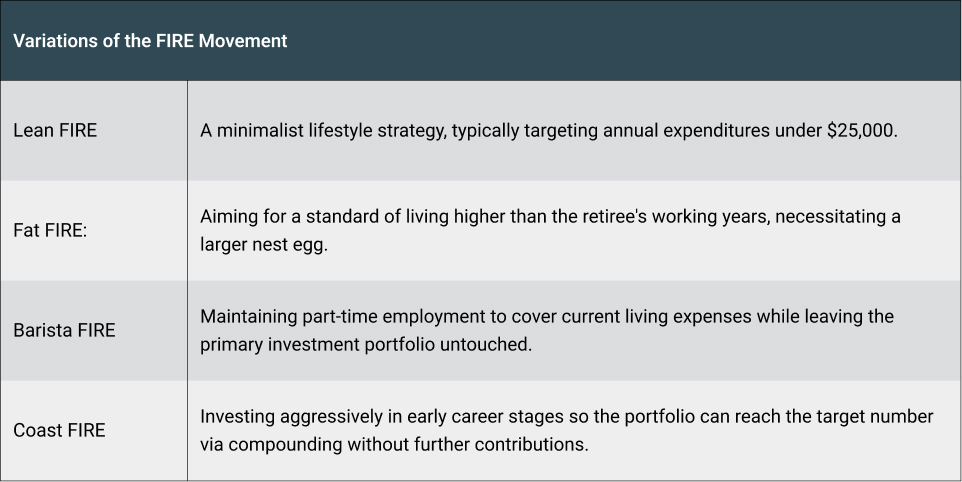
Variations of the FIRE Movement

  • Lean FIRE: A minimalist lifestyle strategy, typically targeting annual expenditures under $25,000.
  • Fat FIRE: Aiming for a standard of living higher than the retiree's working years, necessitating a larger nest egg.
  • Barista FIRE: Maintaining part-time employment to cover current living expenses while leaving the primary investment portfolio untouched.
  • Coast FIRE: Investing aggressively in early career stages so the portfolio can reach the target number via compounding without further contributions.

Step 7 & Beyond: Protecting Your Portfolio

Step 7: Guard Against Market Risk and Longevity Risk

Sequence of Returns Risk happens when a market drop early in retirement damages your portfolio for decades. Selling stocks at a loss early can make it hard to recover.

  • Cash Buffer: Keep 1–2 years of expenses in cash to avoid selling during downturns
  • Flexible Spending: Reduce discretionary spending during bad market years to protect your principal
  • Social Security Planning: Delaying benefits increases long-term, inflation-adjusted income. In a household, one partner might wait until 70 while the other claims at 65 for immediate cash flow and survivor benefits

Beyond?

The 25x Rule and 4% guideline are essential starting points, but personal variables—like location, healthcare needs, and lifestyle changes—mean you’ll need regular reviews. Early retirement is a disciplined strategy combining investments, Section 125 compliance, and tax-efficient withdrawals. Fiduciary advisors can run advanced simulations to make sure your plan survives unpredictable market cycles over decades.

Disclaimer: The information provided is for educational and informational purposes only and should not be construed as personalized investment, tax, or financial planning advice. Every individual’s financial situation is unique, and strategies discussed may not be appropriate for your specific circumstances.

You should consult with a qualified financial advisor, tax professional, or other appropriate professional before implementing any financial strategy.

Investment advisory services are offered through Financial Advisors Network, Inc., a Registered Investment Advisor. Advisory services are provided only to clients under a written agreement and after a thorough review of their individual financial circumstances.

All investments involve risk, including the potential loss of principal. Past performance does not guarantee future results. Any examples, illustrations, or strategies referenced are for informational purposes only and are not intended to represent specific recommendations or guarantees of performance.

Investing in FTDs involves unique risks, including possible loss of principal. Funds may be idle in cash before and/or between FTD opportunities. Taxes will differ depending upon the type of funds used (taxable tax-deferred, or tax-free). There is no assurance that tht techniques and strategies discussed are suitable for all investors or will yield positive outcomes.

Every FTD investment opportunity is comprised of multiple investors. Not all clients are considered qualified. All FAN clients that invest in FTDs will be required to attend or view a recording of a FTD informational session and sign our Millennium Trust Company and First Trust Deed Investments ADV Disclosure Addendum as well as complete investment paperwork through Macoy. If clients decide to participate, they will continue to pay their household’s FAN’s advisory fee on the amount of the FTD investment as agreed upon in your FAN Wrap Fee Agreement. More information regarding the unique risks of FTD investments can be found in our SEC ADV Firm Brochure.

Turn Bulletins into Action

Stay informed—then come in for a free consultation and see how the updates apply to your financial life.

How did you find us?
Thank you! Your submission has been received!
Oops! Something went wrong while submitting the form.