
How to Create the Best Retirement Portfolio

Portfolio Allocation: Retirement Strategies

For high-net-worth individuals (HNWIs) with upwards of $1 million in investable assets, retirement planning becomes significantly more complex. At this level of wealth, the traditional retail models of accumulation and asset selection no longer suffice. The objective shifts from "beating the market" to structural optimization—designing a robust financial vessel that can navigate multi-decade economic cycles while minimizing the risks caused by taxation, inflation, and regulatory shifts.

Retirement portfolios are not one-time events you just build and leave; they are data-driven processes that require moving past generic advice toward specialized money-making architecture. In this guide, we’ll analyze the structural requirements of a high-net-worth portfolio, centering on the three-bucket investment structure, advanced asset location, and the integration of alternative markets.

The Foundation: Data Over Guesswork

A successful retirement requires a detailed plan built on accurate data and realistic assumptions. It has to be defined using financial modeling, scenario analysis, and data verification to remove uncertainty. For California residents, this modeling is particularly important because taxes are often the largest expense retirees underestimate.

The California tax environment, characterized by high state income tax rates, makes the benefits of sheltering income-producing assets even more pronounced. Without a plan that accounts for federal and state tax interaction, a $5 million portfolio can easily lose over $25,000 annually to unnecessary tax drag. And that plan needs to show you the data, plainly, because transparency in the numbers is the only way to ensure your strategy is resilient.

How to Create the Best Retirement Portfolio
Image Caption: Diversification across multiple return sources.

The Tri-Modular Architecture: The Three-Bucket Strategy

The cornerstone of a sophisticated retirement plan is tax diversification. By spreading


investments across three distinct "tax buckets," you gain the control and flexibility


needed to adapt to changing tax laws and manage your annual taxable income with


Precision. Here’s how the 3-bucket retirement income portfolio works:

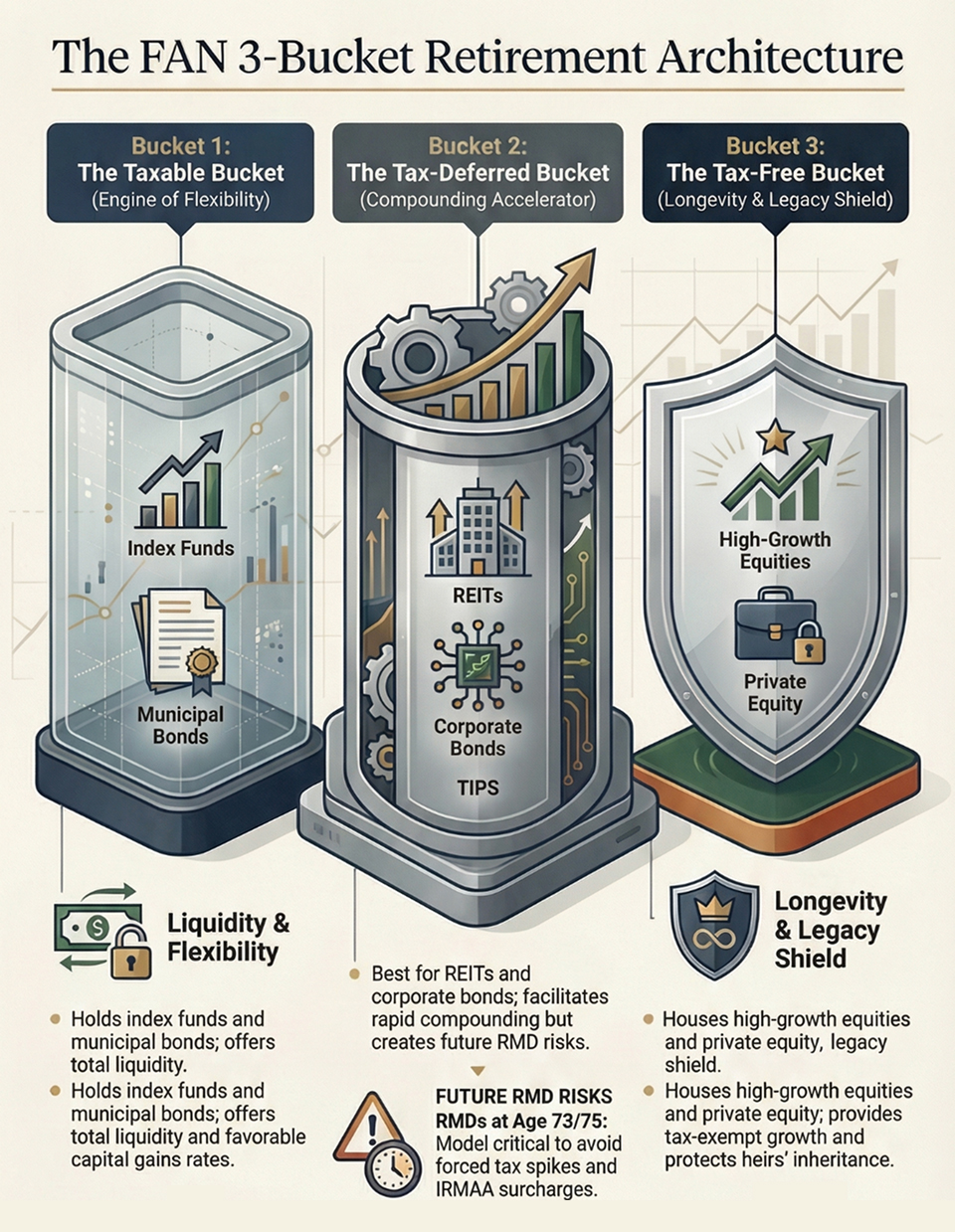
1. The Taxable Bucket (The Flexibility Engine)


This bucket includes traditional brokerage accounts, joint accounts, and high-yield savings vehicles funded with after-tax dollars.

  • Role: It serves as your primary engine for liquidity and flexibility.
  • Tax Treatment: Earnings—such as dividends and interest—are taxed annually, and realized capital gains are subject to taxation upon sale.
  • California Advantage: For those in high tax brackets, this is the ideal home for municipal bonds, as their interest is exempt from federal—and often state—income taxes.

2. The Tax-Deferred Bucket (The Compounding Accelerator)

This bucket holds Traditional IRAs, 401(k)s, and 403(b)s.

  • Role: Contributions provide an immediate reduction in current taxable income, allowing a larger amount of capital to remain invested and compounding over decades.
  • The Risk: This bucket represents a future tax liability. Every dollar withdrawn is taxed as ordinary income. For HNWIs, the primary risk here is the ticking tax clock of Required Minimum Distributions (RMDs) starting at age 73 or 75, which can trigger spikes in taxable income and surcharges on Medicare premiums.

3. The Tax-Free Bucket (The Longevity and Legacy Shield)

Composed of Roth IRAs, Roth 401(k)s, and Health Savings Accounts (HSAs), this is the most valuable "real estate" in a portfolio.

  • Role: Because growth and qualified withdrawals are entirely exempt from federal income tax, these accounts are your best defense against future tax rate increases.
  • Legacy Benefit: Roth accounts do not have RMD requirements for the original owner, allowing assets to compound tax-free for life and pass to heirs with no income tax liability.

Strategic Asset Location: Capturing "Tax Alpha"

Asset allocation determines what you own, but asset location determines where you own it. For a portfolio exceeding $1 million, a thoughtful asset location strategy can add between 1% and 2% to annual after-tax returns, a gain often referred to as "Tax Alpha".

The data-driven principle is simple: match tax-inefficient assets with tax-advantaged buckets and tax-efficient assets with taxable buckets.

  • Tax-Deferred Bucket: This is where you should locate assets that generate substantial ordinary income, such as taxable corporate bonds, REITs, and high-turnover mutual funds.
  • Tax-Free (Roth) Bucket: Reserve this space for your highest expected-growth assets, such as small-cap equities or aggressive growth funds. This ensures that the assets with the greatest appreciation potential are the ones that will never be taxed again.
  • Taxable Bucket: This bucket should house low-turnover index funds, ETFs, and municipal bonds.

For Californians, Direct Indexing is a great tool for the taxable bucket. By owning the individual stocks of an index rather than a fund, you can execute security-level tax-loss harvesting to offset capital gains elsewhere in your financial life, potentially saving thousands in annual taxes.

Dynamic Withdrawal Strategy: The "Guardrails" Approach

Rigid withdrawal rules, like the standard 4% rule, regularly fail to adapt to market volatility. For the high-net-worth retiree, we recommend a dynamic withdrawal strategy using proper guardrails.

This approach establishes a target withdrawal rate (e.g., 5%) with preset upper and lower bounds—typically 20% above and below the initial portfolio value.

  • The Upper Guardrail: If strong market performance pushes your portfolio above the upper limit, you can increase your withdrawal to enjoy more of your wealth.
  • The Lower Guardrail: If a market downturn occurs, you reduce your withdrawal to preserve capital and mitigate sequence of returns risk—the danger that early losses in retirement paired with withdrawals permanently impair the portfolio's longevity.

Navigating the 2026 Regulatory Landscape

The One Big Beautiful Bill Act (OBBBA) has fundamentally reshaped the tax landscape. Key provisions for HNWIs include a permanent federal estate and gift tax exemption of $15 million per individual ($30 million for married couples), adjusted for inflation.

For California residents, managing Required Minimum Distributions remains a critical objective. The years between retirement and age 73 represent a "golden opportunity" or "tax valley". During these years, you may have lower taxable income, allowing you to execute partial Roth conversions at lower tax rates to reduce the size of the "tax time bomb" in your deferred accounts later.

Retirement Planning Requires Passion and Precision

Remember, building a recommended retirement portfolio is not a one-time calculation; it’s a year-by-year strategy. The right plan must adapt to changing tax legislation, market volatility, and your unique family dynamics.

Retirement planning requires time, knowledge, and passion. If you don’t have all three, it’s essential to find an advisor who does, so that they can dedicate their expertise fully to keeping you in the best financial circumstances throughout your retirement.

The goal of a financial plan isn't prediction so much as preventing unpleasant surprises. By integrating the three-bucket structure with data-driven asset location and dynamic withdrawal rules, you can achieve the peace of mind that comes from knowing your financial future is planned, controlled, and resilient.

Disclaimer: The information provided is for educational and informational purposes only and should not be construed as personalized investment, tax, or financial planning advice. Every individual’s financial situation is unique, and strategies discussed may not be appropriate for your specific circumstances.

You should consult with a qualified financial advisor, tax professional, or other appropriate professional before implementing any financial strategy.

Investment advisory services are offered through Financial Advisors Network, Inc., a Registered Investment Advisor. Advisory services are provided only to clients under a written agreement and after a thorough review of their individual financial circumstances.

All investments involve risk, including the potential loss of principal. Past performance does not guarantee future results. Any examples, illustrations, or strategies referenced are for informational purposes only and are not intended to represent specific recommendations or guarantees of performance.

Investing in FTDs involves unique risks, including possible loss of principal. Funds may be idle in cash before and/or between FTD opportunities. Taxes will differ depending upon the type of funds used (taxable tax-deferred, or tax-free). There is no assurance that tht techniques and strategies discussed are suitable for all investors or will yield positive outcomes.

Every FTD investment opportunity is comprised of multiple investors. Not all clients are considered qualified. All FAN clients that invest in FTDs will be required to attend or view a recording of a FTD informational session and sign our Millennium Trust Company and First Trust Deed Investments ADV Disclosure Addendum as well as complete investment paperwork through Macoy. If clients decide to participate, they will continue to pay their household’s FAN’s advisory fee on the amount of the FTD investment as agreed upon in your FAN Wrap Fee Agreement. More information regarding the unique risks of FTD investments can be found in our SEC ADV Firm Brochure.

Turn Bulletins into Action

Stay informed—then come in for a free consultation and see how the updates apply to your financial life.

How did you find us?
Thank you! Your submission has been received!
Oops! Something went wrong while submitting the form.