
8 Essential Retirement Income Strategies

Financial Advice—Retirement Planning

Retirement planning today is quite a bit different than it used to be. Old tax rules have phased out, and the One Big Beautiful Bill Act (OBBBA) is fully in play. If you’re retiring in California, you’re juggling high living costs, new rules about how you can pull money from accounts, and some fresh federal tax breaks. The biggest challenges? Keeping your money’s buying power in an inflation-heavy world and figuring out state taxes.

So what is the best way to save for retirement?

Here’s some essential retirement planning advice: eight strategies to help you make the most of your retirement income. They’re practical, based on the latest laws, and designed to help your savings last for decades. Just make sure to consult a retirement advisor before implementing any of them, as you need a plan that’s as individual as your circumstances.

Leveraging Local Tax Shields and High-Yield Fixed Income

1. Delay Social Security and Use the California Shield

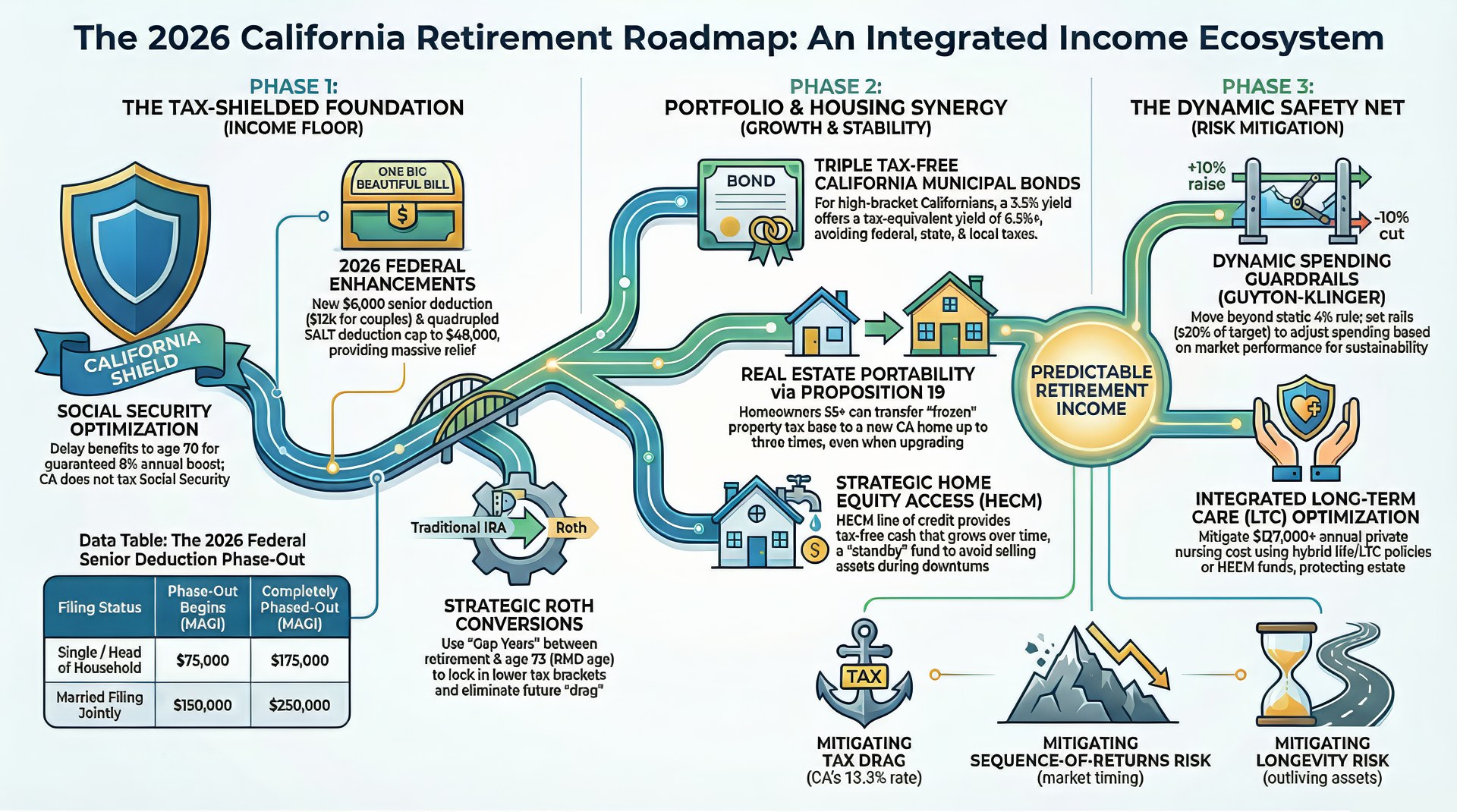
California doesn’t tax Social Security, while the federal government can tax up to 85%. For a typical retired couple, this can protect nearly $1 million from state taxes over 20 years. Waiting until age 70 to claim your benefits can increase your guaranteed income by about 8% per year, giving you more tax-free money and peace of mind for the long run.

2. Invest in Triple Tax-Free California Municipal Bonds

Some California municipal bonds are tax-free at the federal, state, and local level. For high earners, that’s a huge win compared with taxable bonds. A bond paying 3.5% tax-free can work like it’s paying over 6% in a regular account—so your money stretches further every year.

Making the Most of Your Home

3. Take Advantage of Prop 19 for Property Taxes

If you’re 55+ and selling your home, Prop 19 lets you transfer your property tax base to a new home up to three times anywhere in California. You can even move into a more expensive home with a small upward adjustment.

Quick Rules:

  • Move anywhere in California
  • Replacement home can be more expensive
  • Can use the benefit 3 times
  • Heirs must live in the property to keep the low tax base

100%/105%/110% Rule: The sooner you buy the new home after selling, the closer you stay to your old low tax base. Buy before selling → 100% of old base. Buy within 1 year → 105%. Buy within 2 years → 110%. File within 3 years or you lose the benefit.

4. Tap Home Equity with a Reverse Mortgage (HECM)

A reverse mortgage lets homeowners 62+ access their home’s equity without monthly payments. This kind of financial planning can act as a backup for income gaps or long-term care costs. You need to keep the home as your main residence and stay current on taxes and insurance. This strategy is especially helpful in California, where your home often makes up the bulk of your wealth.

8 Essential Retirement Income Strategies

Smart Federal Moves and Tax-Efficient Conversions

5. Roth Conversions During Gap Years

Between retirement and when required minimum distributions (RMDs) start at 73–75, there’s a “gap year.” Moving some money into a Roth IRA during these low-income years locks in tax-free growth and reduces taxes later. Roth IRAs also don’t require withdrawals during your life, giving you more control and leaving a better inheritance.

6. Take Advantage of OBBBA Enhancements ($6,000 Deduction + SALT Cap)

OBBBA gives a $6,000 senior deduction for those 65+ through 2028. Combined with standard and extra senior deductions, a single retiree can get $23,750 in tax-free income, and a couple gets $47,500. Also, the SALT deduction cap has risen to $40,000, which is great news for California homeowners with high property taxes.

Protecting Against Running Out of Money and High Healthcare Costs

7. Use Dynamic Spending Guardrails

The Guyton-Klinger method helps you adjust your withdrawals based on how your portfolio performs. Instead of taking a fixed percentage every year, you set a target with upper and lower limits.

  • If your investments do well, you can spend a bit more
  • If the market drops, you spend less to protect your savings

This approach helps you avoid overspending in bad years while still enjoying your money when times are good.

8. Plan for Long-Term Care

Nursing care in California is expensive—over $118k per year for semi-private rooms. Medicare only covers a fraction. Hybrid insurance policies combine life insurance with long-term care, letting you access funds if needed. Health Savings Accounts (HSAs) are another tax-advantaged way to cover medical costs later. Planning early is key, because premiums rise as you age and health issues can block coverage.

Implementing retirement savings strategies today involves mixing state-specific tax breaks with federal perks. Using Social Security exemptions, Prop 19 portability, the $40,000 SALT cap, and senior deductions can seriously reduce your living costs. Because markets and healthcare costs fluctuate, though, it’s wise to get retirement advice to review your plan every year. Then you can maintain your lifestyle, keep your savings safe, and enjoy retirement without financial stress.

Disclaimer: The information provided is for educational and informational purposes only and should not be construed as personalized investment, tax, or financial planning advice. Every individual’s financial situation is unique, and strategies discussed may not be appropriate for your specific circumstances.

You should consult with a qualified financial advisor, tax professional, or other appropriate professional before implementing any financial strategy.

Investment advisory services are offered through Financial Advisors Network, Inc., a Registered Investment Advisor. Advisory services are provided only to clients under a written agreement and after a thorough review of their individual financial circumstances.

All investments involve risk, including the potential loss of principal. Past performance does not guarantee future results. Any examples, illustrations, or strategies referenced are for informational purposes only and are not intended to represent specific recommendations or guarantees of performance.

Investing in FTDs involves unique risks, including possible loss of principal. Funds may be idle in cash before and/or between FTD opportunities. Taxes will differ depending upon the type of funds used (taxable tax-deferred, or tax-free). There is no assurance that tht techniques and strategies discussed are suitable for all investors or will yield positive outcomes.

Every FTD investment opportunity is comprised of multiple investors. Not all clients are considered qualified. All FAN clients that invest in FTDs will be required to attend or view a recording of a FTD informational session and sign our Millennium Trust Company and First Trust Deed Investments ADV Disclosure Addendum as well as complete investment paperwork through Macoy. If clients decide to participate, they will continue to pay their household’s FAN’s advisory fee on the amount of the FTD investment as agreed upon in your FAN Wrap Fee Agreement. More information regarding the unique risks of FTD investments can be found in our SEC ADV Firm Brochure.

Turn Bulletins into Action

Stay informed—then come in for a free consultation and see how the updates apply to your financial life.

How did you find us?
Thank you! Your submission has been received!
Oops! Something went wrong while submitting the form.