.jpg)
Estate Planning Essentials for Everyone
Estate planning is one of the most important steps individuals and families can take to protect their finances, healthcare decisions, and loved ones. While many people believe estate planning is only for the wealthy, the reality is that every adult can benefit from having basic legal documents in place.
A thoughtful estate plan helps ensure your wishes are followed if you become incapacitated or pass away. It can reduce confusion, minimize family conflict, avoid unnecessary court involvement, and provide peace of mind.
While you should always consult a qualified estate planning attorney, for educational purposes only, here is an overview of some of the core estate planning documents every individual can benefit from understanding.
Durable Power of Attorney
A Durable Power of Attorney (DPOA) is a legal document that allows you to appoint someone you trust to handle financial and legal matters on your behalf if you become unable to do so yourself.
The individual you appoint is commonly called your “agent” or “attorney-in-fact.”
What a Durable Power of Attorney Can Do:
Depending on how the document is written, your agent may have authority to:
- Pay bills and manage bank accounts
- Handle investment accounts
- File taxes
- Manage retirement accounts
- Buy or sell property
- Sign contracts
- Coordinate long-term care expenses
The word “durable” means the document remains effective even if you become mentally or physically incapacitated.
Without a Durable Power of Attorney, family members may need to petition the court for guardianship or conservatorship to manage your affairs. This process can be expensive, time-consuming, and emotionally difficult.
A properly drafted DPOA can help families avoid unnecessary legal proceedings and maintain continuity during medical emergencies or cognitive decline.
Selecting the right person is critical. Your agent should be:
- Financially responsible
- Organized
- Trustworthy
- Able to handle stress and difficult decisions
- Willing to act in your best interests
Many people appoint a spouse, adult child, sibling, or trusted advisor.
Healthcare Proxy and Medical Directives
A Healthcare Proxy (sometimes called a Medical Power of Attorney) allows you to designate someone to make medical decisions on your behalf if you are unable to communicate your wishes.
This document works alongside other healthcare directives, including living wills and HIPAA authorizations.
What a Healthcare Proxy Covers:
Your designated healthcare agent may help make decisions regarding:
- Medical treatments
- Surgeries and procedures
- Medication management
- Long-term care
- Rehabilitation services
- End-of-life care decisions
The document only becomes active when you are unable to make or communicate decisions yourself.
A Living Will outlines your preferences regarding life-sustaining treatment and end-of-life care. It may address topics such as:
- Artificial nutrition and hydration
- Mechanical ventilation
- Resuscitation wishes
- Pain management preferences
- Organ donation instructions
Having these instructions documented can relieve loved ones from making emotionally difficult decisions without guidance.
A HIPAA Authorization allows designated individuals access to your medical information.
Without proper authorization, doctors and healthcare providers may be limited in what they can discuss with family members due to privacy laws.
Healthcare documents matter because medical emergencies often occur unexpectedly. Having healthcare documents in place ensures:
- Your wishes are respected
- Loved ones can communicate with doctors
- Medical decisions can be made quickly
- Family disputes may be reduced during emotional situations
Last Will and Testament
A Last Will and Testament is a foundational estate planning document that outlines how your assets should be distributed upon your death.
It also allows you to appoint guardians for minor children and name an executor to manage your estate.
A Will typically may include and specify:
- Who inherits your property and assets
- Guardians for minor children
- An executor to carry out your wishes
- Specific gifts to individuals or charities
- Instructions for personal belongings
The role of the executor can include:
- Gathering estate assets
- Paying debts and taxes
- Filing necessary legal documents
- Distributing assets according to the will
Choosing a responsible and organized executor is extremely important.
A will generally must go through probate, which is the court-supervised process of validating the will and distributing assets.
Probate laws vary by state, but probate may involve:
- Court filings
- Public records
- Legal fees
- Potential delays
While probate is not always problematic, many individuals use trusts and additional planning strategies to minimize or simplify the process.
A will does not:
- Avoid probate by itself
- Control jointly owned assets
- Override beneficiary designations on retirement accounts or life insurance
- Provide incapacity planning
Because of these limitations, wills are often combined with trusts and powers of attorney as part of a broader estate plan.
Trusts
A trust is a legal arrangement that allows assets to be managed for the benefit of another person or group of people.
The person creating the trust is called the “grantor” or “settlor.” The individual managing the trust is the “trustee,” and the people benefiting from the trust are the “beneficiaries.”
Revocable Living Trusts are one of the most common estate planning tools.
With this type of trust:
- You maintain control of the assets during your lifetime
- You can amend or revoke the trust
- Assets may avoid probate after death
- A successor trustee can step in if you become incapacitated
Potential benefits of a Revocable Trust include:
Probate Avoidance - Assets titled properly inside the trust generally avoid probate court.
Privacy - Unlike wills, trusts are typically private documents and do not become part of the public record.
Incapacity Planning - If you become incapacitated, the successor trustee can continue managing trust assets without court intervention.
Efficient Asset Distribution - Trusts may help streamline the transfer of assets after death.
Irrevocable Trusts are more restrictive and generally cannot be easily changed once created.
These trusts may be used for:
- Asset protection strategies
- Estate tax planning
- Charitable planning
- Medicaid planning
- Life insurance planning
Before considering any trust, please consult with a qualified attorney first. Trusts involve complex legal and tax considerations; therefore, professional guidance is essential.
Beneficiary Designations
Outdated beneficiaries are one of the most common estate planning mistakes. Many financial assets transfer through beneficiary designations rather than through a will.
These may include:
- Retirement accounts
- Life insurance policies
- Annuities
- Transfer-on-death accounts
It is important to regularly review beneficiary designations to ensure they align with your overall estate plan.
Updating Your Estate Plan
Estate planning is not a one-time event. Documents should be reviewed periodically and updated after major life events such as:
- Marriage or divorce
- Birth of children or grandchildren
- Death of a family member
- Significant financial changes
- Retirement
- Relocation to another state
Laws and family circumstances evolve over time, making regular estate planning reviews essential.
Final Thoughts
Estate planning is about far more than distributing assets. It is about protecting your family, preserving your wishes, and creating clarity during life’s most difficult moments.
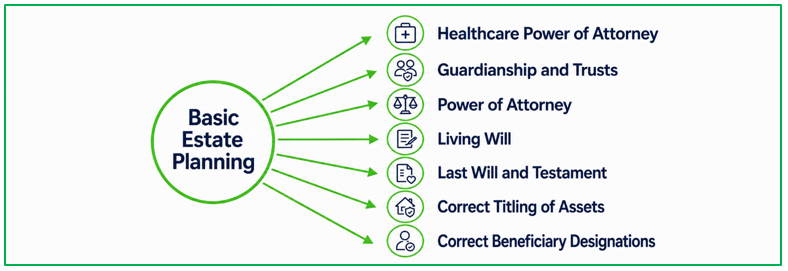
At a minimum, individuals should consider having:
- A Durable Power of Attorney
- Healthcare directives and proxy documents
- A Last Will and Testament
- Trust planning where appropriate
- Updated beneficiary designations
Working with qualified estate planning attorneys, tax professionals, and financial advisors can help ensure your plan reflects your goals and remains aligned with current laws and family needs.
A well-designed estate plan provides more than legal protection - it provides confidence, organization, and peace of mind for both you and the people you care about most.
We believe an informed client is the best client. We would welcome the opportunity to discuss your estate plan with you. Our commitment is to always offer you consistent and meaningful communication and to proactively help you. We encourage you to share any concerns you have with us. Our team is here to help you with every step of your journey toward your financial goals. We greatly value the trust and confidence you place in our firm and look forward to continuing to serve you.
Please share this information with others!
This year, one of our goals is to offer our services to several other people just like you! Do you know someone who could benefit fromour services?
If you know someone who could benefit from professional financial guidance, we'd be honored if you would:
- Add their name to our mailing list to receive valuable and timely information.
- Invite them to join one of our upcoming webinars, client appreciation events, or retirement classes
- Encourage them to schedule a complimentary financial consultation
To connect us, please call us at (714) 597-6510 or email info@fanwmg.com. We'd love the opportunity to learn about their goals and explore how we can help them achieve financial confidence and success.
Upcoming Events
- Retirement Classes | Sep - Oct
- ID Theft Prevention Webinar | Wed, Sep 9 at 9pm PT
- Investments Webinar | Wed, Oct 7 at 6pm PT
- Property Inheritance Webinar | Wed, Oct 14 at 6pm PT
- Social Security & Medicare Webinar | Wed, Oct 21 at 6pm PT
- Understanding Dementia & Alzheimer's Disease Webinar | Wed, Oct 28 at 6pm PT
- Tax Planning & Update Webinar | Wed, Nov 4 at 6pm PT
Click HERE to learn more about our upcoming events.
Financial Advisors Network, Inc. is a registered investment advisory firm. This article is for informational purposes only. This information is not intended to be a substitute for specific individualized tax, legal or investment planning advice as individual situations will vary. For specific advice about your situation, please consult with a lawyer, tax or financial professional. The information contained in this report does not purport to be a complete description of the securities, markets, or developments referred to in this material. The information has been obtained from sources considered to be reliable, but we do not guarantee that the foregoing material is accurate or complete. Any information is not a complete summary or statement of all available data necessary for making an investment decision and does not constitute a recommendation.
This information is not intended to be a substitute for specific individualized tax advice. We suggest that you discuss your specific situation with a qualified tax professional.
Source: Reviewed by Keebler and Associates. Contents provided by the Academy of Preferred Financial Advisors, 2026
Turn Bulletins into Action
Stay informed—then come in for a free consultation and see how the updates apply to your financial life.