
3rd Quarter 2026 Newsletter
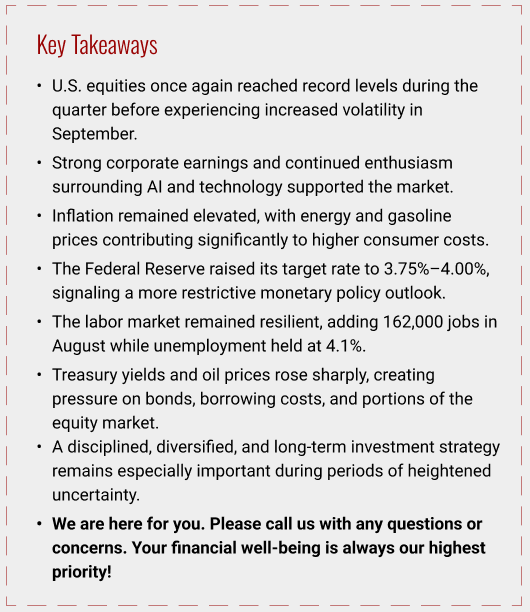
The third quarter of 2026 reinforced an important lesson for investors: even healthy markets can experience periods of heightened volatility. During the quarter, equities once again reached record levels that were fueled by strong corporate earnings, continued economic growth and investor optimism surrounding artificial intelligence and technological innovation. However, markets also reacted to renewed inflation concerns, rising interest rates, elevated Treasury yields, and continued instability in the Middle East, which prompted increased market fluctuations as the quarter progressed.
During the first two months of the quarter, equity markets progressed before facing pressure in September after the Federal Reserve decided to increase interest rates. Wall Street initially reacted to the rate increase with a drop in equities, but quickly returned to an upward trajectory. Additional sources of investor uncertainty during the quarter included higher oil prices and rising bond yields.
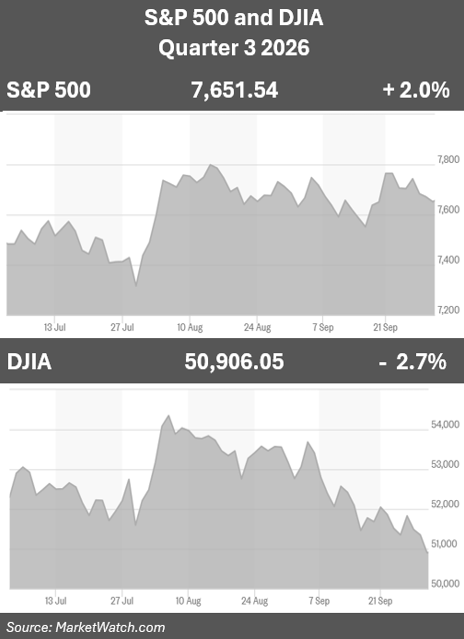
Following strong second-quarter rebounds, the major indexes delivered mixed results during the third quarter. The S&P 500 closed September 30 at 7,651.54, with a gain of approximately 2.0% for the quarter, while the Dow Jones Industrial Average finished at 50,906.05, declining approximately 2.7%. Despite the Dow’s quarterly decline, both indexes remained positive for the year, with the S&P 500 up over 12% and the Dow up approximately 5.9% (Associated Press; Investopedia, September 30, 2026).
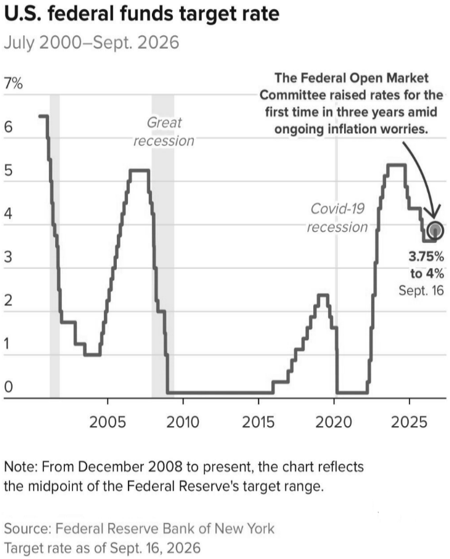
Led by the new Chair Kevin Warsh, the September Federal Open Market Committee (FOMC) voted to increase the federal funds interest rate range from 3.50% - 3.75% to 3.75% - 4.00%. This was the first time the range was increased since July 2023.
The energy sector continued to be one of the largest contributors to market volatility. Brent crude oil climbed from approximately $72 per barrel earlier in the summer to nearly $110 before retreating near $100. Gasoline prices in turn rose sharply as the conflict involving Iran and uncertainty surrounding the Strait of Hormuz renewed concerns about global energy supplies. As of the end of the third quarter, consumers still felt the pain of high gas pump prices and inflation due to high oil prices.
The labor market continued to demonstrate resilience. Employers added 162,000 jobs in August, and the unemployment rate remained unchanged at 4.1%. Consumer spending also remained relatively healthy, helping support continued economic growth despite higher gasoline prices and borrowing costs. At the same time, the combination of elevated inflation, higher interest rates, and slowing growth in certain parts of the economy suggests that conditions may become more challenging in the months ahead (U.S. Bureau of Labor Statistics; 9/4/26).
What is fueling the equity markets’ resilience to volatility?
Strong corporate earnings remained one of the market’s greatest underlying supports. According to Barron’s, not all stocks advanced equally. They cited that four tech stocks (Nvidia, Micron, Apple, and Advanced Micro Devices) are responsible for almost half of the S&P 500’s year-to-date performance.
As of September 11, FactSet estimated that S&P 500 companies were on schedule to report year-over-year earnings growth of 28.7% for the third quarter. This would represent the eighth consecutive quarter of double-digit earnings growth. Technology, communication services, and energy companies were cited as the quarter’s strongest contributors (FactSet; 9/11/26; Barron’s 10/2/26).
Overall, the third quarter continued to support an important investment principle: while many things can cause short-term market volatility, long-term market performance is ultimately driven by healthy, long-term focused fundamentals. Healthy corporate earnings, a resilient labor market, and continued investment in technology have provided support for the economy and equity markets. However, persistent inflation, higher interest rates, elevated oil prices, and geopolitical uncertainty are likely to remain important areas to watch as investors approach the final quarter of 2026.
As financial professionals, our role is to closely monitor economic and market developments. Our goal is to support you through all market conditions and help ensure your portfolio remains aligned with your broader financial goals. We remain committed to keeping you informed, prepared, and well-positioned to navigate changing market conditions with confidence.
Inflation & Interest Rates
Key Points:
- The Federal Reserve raised the federal funds rate range from 3.50%–3.75% to 3.75% - 4.00%.
- Inflation remains above the Fed's long-term target and continues to be a primary concern.
- Updated Federal Reserve projections suggest that an additional rate increase may be possible before the end of 2026.
During the first half of 2026, the Federal Open Market Committee (FOMC) kept its benchmark federal funds rate unchanged, maintaining the target range at 3.50%–3.75%, maintaining its benchmark rate the same for five consecutive meetings.
Then during their September meeting, the FOMC committee voted unanimously to increase the federal funds rate range by 25 basis points up to 3.75% - 4.00%. This was the first time the range was increased since July 2023. This decision reflected continued concern that inflation remained above the Federal Reserve’s long-term 2% target.
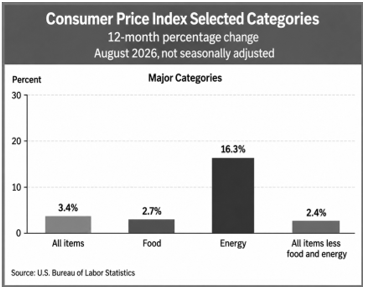
Inflation data released during the third quarter supported the Federal Reserve’s more cautious approach. According to the Bureau of Labor Statistics, the Consumer Price Index increased 3.4% over the 12 months ending in August. Core CPI, which excludes food and energy, increased 2.4% over the same period. Food prices rose 2.7%, while shelter costs increased 3.0% from a year earlier. (Source: Bureau of Labor Statistics, September 11, 2026)
Energy prices remained a significant contributor to inflation. The energy index increased by a sharp 16.3% over the 12 months ending in August, driven largely by a 27.4% increase in gasoline prices. Gasoline prices also rose 3.9% during August alone and accounted for more than one-third of the monthly increase in consumer prices. Continued instability in the Middle East and concerns surrounding the movement of oil through the Strait of Hormuz contributed to volatility in global energy markets (Bureau of Labor Statistics, September 11, 2026).
The labor market remained relatively resilient during the quarter. Continued job growth and healthy consumer spending provided support for the economy, although higher gasoline prices, borrowing costs, and inflation continued to place pressure on household budgets (Bureau of Labor Statistics, September 4, 2026).
The September Fed meeting also brought updated economic and inflation projections. FOMC participants slightly increased their median forecast for 2026 headline PCE inflation and improved their 2026 economic growth forecast. Federal Reserve officials also increased their median year-end projection for the federal funds rate from 3.8% in June to 4.1% in September. Because the midpoint of the current target range is approximately 3.9%, this projection suggests that policymakers may consider another quarter-percentage-point increase before the end of the year. Please keep in mind that future decisions will depend on incoming inflation data, labor-market conditions, economic growth, and geopolitical developments (Federal Reserve Summary of Economic Projections, September 16, 2026).
Looking ahead, the possibility of additional rate increases looks realistic. If inflation remains elevated, particularly because of higher energy prices, the Federal Reserve may maintain its restrictive policy stance or raise rates again. Conversely, a sustained decline in inflation or a meaningful slowdown in economic activity could allow policymakers to keep rates unchanged.
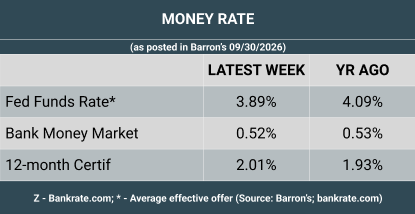
Interest rates and inflation remain critical factors in financial planning and investment decision-making. Higher rates may create challenges for borrowers and certain investments, but they may also provide attractive income opportunities for savers and bond investors. We will continue to monitor Federal Reserve policy, inflation, employment, and economic growth closely and provide updates as conditions evolve.
The Bond Market & Treasury Yields
Key Points:
- Treasury yields moved higher during the quarter due to persistent inflation, elevated energy prices, and FOMC’s September interest rate increase.
- The Treasury yield curve remained positively sloped, although the difference between shorter- and longer-term yields narrowed as expectations for additional rate increases grew.
During the third quarter of 2026, U.S. Treasury yields rose as investors evaluated persistent inflation, higher energy prices, resilient economic activity, and a more restrictive Federal Reserve policy outlook. Yields experienced periods of significant volatility as new economic data and geopolitical developments altered expectations for inflation and future interest-rate decisions.
The Federal Reserve’s September decision also affected the bond market. Following the announcement, shorter-term Treasury yields increased as investors considered the possibility of an additional rate increase before the end of the year. (Source: Federal Reserve, September 16, 2026).
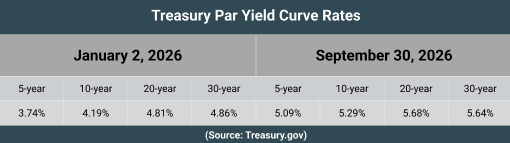
Longer-term Treasury yields moved notably higher during the quarter. The 10-year Treasury yield, which ended in the second quarter at 4.44%, approached and exceeded 5% in September. The increase reflected concerns about persistent inflation, elevated government borrowing, higher oil prices, and the possibility that interest rates may remain higher for longer.
At the end of the third quarter, on September 30, 2026, the 10-year Treasury yield stood at 5.29%, the 5-year Treasury yield at 5.09%, and the 30-year Treasury yield at 5.64%. All three were above 5% for the first time in many years (U.S. Department of the Treasury, Daily Treasury Par Yield Curve Rates, September 30, 2026).
The Treasury yield curve remained positively sloped, with the 10-year yield above the 2-year yield and the 30-year yield above both shorter maturities. However, the difference between the 2-year and 10-year yields narrowed as shorter-term yields increased in response to the Federal Reserve’s more hawkish outlook. This flattening suggests investors expect monetary policy to remain restrictive in the near term, while also demanding higher yields on longer-term securities because of inflation and fiscal uncertainty.
Higher Treasury yields can create both challenges and opportunities for investors. Bond prices struggled during the quarter as rising yields placed downward pressure on the market value of existing bonds, particularly longer-duration bonds. At the same time, newly issued bonds and other fixed-income investments offered more attractive income than they have in recent years.
Although expectations for future interest-rate adjustments will continue to change, Treasuries and bonds remain an important component of diversified investment portfolios. Please remember that diversification can help manage investment risk, but it does not ensure a profit or guarantee against loss.
As always, bond investments should be evaluated within the context of an investor’s risk tolerance, time horizon, income needs, and overall financial objectives. Bonds remain a core component of many well-balanced portfolios, and we will continue to monitor Federal Reserve policy, inflation, Treasury yields, and economic conditions as they evolve.
Oil
Key Points:
- Gasoline prices remained elevated during the third quarter.
- Continued uncertainty in the Middle East remains an important risk for inflation and financial markets.
Energy prices continued to place pressure on consumers during the third quarter of 2026. According to AAA, the national average price for regular gasoline was $4.33 per gallon during September, exceeding the previous September record of $3.83 set in 2023. Although prices began to ease as the quarter ended, fuel costs remained unusually high for this time of year (AAA, October 1, 2026).
The outlook for crude oil remains closely tied to developments in the Middle East. Despite improvements in some export flows, uncertainty surrounding the conflict involving Iran and shipping through the Strait of Hormuz continues to create supply risks. On September 30, a Reuters survey showed that analysts had raised their forecast for average Brent crude prices in 2026 to $89.05 per barrel, compared with $85.08 in the previous month’s survey. These figures represent projected full-year averages, rather than current trading prices (Reuters, September 30, 2026).
For investors, energy prices remain an important part of the economic outlook. Sustained declines could help ease inflation, reduce operating costs for businesses, and leave consumers with more money for other purchases. Conversely, renewed supply disruptions could push prices higher and complicate the Federal Reserve’s efforts to bring inflation under control.
As we enter the final quarter of 2026, we remain mindful that energy markets can change quickly. We will continue to monitor oil supplies, gasoline prices, and geopolitical developments, evaluating their potential impact on inflation, interest rates, corporate earnings, and your broader financial goals.
Investors’ Outlook
Key Points:
- We remain cautiously optimistic. Strong earnings expectations provide an encouraging backdrop, while persistent inflation, higher interest rates, and geopolitical uncertainty could contribute to additional volatility.
- Maintaining a disciplined investment strategy and proactively reviewing your financial plan remain essential as we approach the end of 2026.
As we enter the final quarter of 2026, investors have reasons for optimism, along with several important developments to monitor. Corporate earnings expectations remain strong, but inflation and the direction of Federal Reserve policy continue to influence the outlook. In the months ahead, we will be watching to see if companies can deliver on those expectations and if current inflationary pressures begin to ease.
Corporate earnings remain an encouraging part of the investment landscape. As of October 2, FactSet projected year-over-year earnings growth of 29.5% for S&P 500 companies in the third quarter and 27.6% for the fourth quarter. (Source: FactSet, October 2, 2026)
“Heading into the start of the earnings season, analysts and companies have been more optimistic than normal in their earnings outlooks for the third quarter,” according to FactSet’s S&P 500 Earnings Season Preview: Q3 2026. These projections provide a reason for cautious optimism, although estimates can change and stronger earnings do not guarantee higher stock prices (FactSet; 10/2/26).
At the same time, inflation remains an important concern. Consumer prices increased 3.4% over the 12 months ending in August, with energy prices continuing to put pressure on household budgets. The Federal Reserve raised its benchmark interest-rate range to 3.75%–4.00% in September, underscoring its commitment to addressing inflation. The direction of interest rates will depend on incoming economic data and the balance between inflation risks and labor conditions (U.S. Bureau of Labor Statistics, September 11, 2026; Federal Reserve, September 16, 2026).
While we remain cautiously optimistic, investors should be prepared for changing conditions. A sustained easing of inflation and energy costs could provide a more favorable environment for businesses and consumers. Conversely, renewed supply disruptions or additional interest-rate increases could create further challenges. These possibilities reinforce the importance of having an investment strategy set up to survive a range of outcomes.
We are not in the business of predicting the markets. Our focus is on supporting our clients and their long-term financial goals. We understand that daily headlines can create a sense of urgency and panic, but please keep in mind that they should not dictate making changes to your carefully developed investment plan. Your objectives, time horizon, income needs, and risk tolerance should remain the foundation of your investment decisions. We will continue to closely monitor market developments and make thoughtful portfolio adjustments when appropriate, always with your long-term goals at the forefront of our investment decisions.
While short-term volatility is likely to remain, please remember that volatility is a normal part of investing. Periods of market weakness may offer opportunities to rebalance portfolios, invest at more attractive prices, or evaluate tax-loss harvesting where appropriate. Higher yields may also create income opportunities. Each decision should be considered in the context of your overall financial situation. Diversification can help manage risk, but it does not guarantee a profit or protect against loss.
We believe an informed client is the best client. As year-end approaches, we encourage you to review your financial plan to identify any items that may require attention before December 31.
Our goal is to exceed our clients’ expectations by delivering exceptional service, maintaining consistent and meaningful communication throughout the year, and proactively planning to help clients navigate the changing economic environment. We will attempt to keep you informed about developments that could impact your personal situation, and as always, we encourage you to inform us of any changes to your circumstances, risk tolerance, or time horizon.
Our team is here to help you with every step of your journey towards your financial goals. Please feel free to reach out to us with any questions or concerns you may have.
We would like to help more people like you!
Many of our best relationships have come through introductions from clients. We would be honored if you:
- Add a name to our mailing list.
- Briang a guest to our retirement classes or webinars
- Encourage someone to schedule a complimentary financial consultation.
Please call us at (714) 597-6510 or email info@fanwmg.com, and we woudl be happy to explore how we can help them with their financial goals.
Upcoming Events
- Understanding Dementia & Alzheimer's Disease Webinar | Wed, Oct 28 at 6pm PT
- Tax Planning & Update Webinar | Wed, Nov 4 at 6pm PT
Click HERE to learn more about our upcoming events.
Financial Advisors Network, Inc. is a registered investment advisory firm. Note: The views stated in this letter are not necessarily the opinion of Financial Advisors Network, Inc., and should not be construed, directly or indirectly, as an offer to buy or sell any securities mentioned herein. Investors should be aware that there are risks inherent in all investments, such as fluctuations in investment principal. With any investment vehicle, past performance is not a guarantee of future results. Material discussed herewith is meant for general illustration and/or informational purposes only. Please note that individual situations can vary. Therefore, the information should be relied upon when coordinated with individual professional advice. This material contains forward-looking statements and projections. There are no guarantees that these results will be achieved. All indices referenced are unmanaged and cannot be invested into directly. Unmanaged index returns do not reflect fees, expenses, or sales charges. Index performance is not indicative of the performance of any investment. There is an inverse relationship between interest rate movements and bond prices. Generally, when interest rates rise, bond prices fall and when interest rates fall, bond prices generally rise. There is no guarantee that a diversified portfolio will enhance overall returns or outperform a non-diversified portfolio. Diversification does not protect against market risk.
The S&P 500 is an unmanaged index of 500 widely held stocks that is generally considered representative of the U.S. stock market. The modern design of the S&P 500 stock index was first launched in 1957. Performance prior to 1957 incorporates the performance of the predecessor index, the S&P 90. Dow Jones Industrial Average (DJIA), commonly known as “The Dow” is an index representing 30 stocks of companies maintained and reviewed by the editors of the Wall Street Journal. Past performance is no guarantee of future results. CDs are FDIC Insured and offer a fixed rate of return if held to maturity. Due to volatility within the markets mentioned, opinions are subject to change without notice. Information is based on sources believed to be reliable; however, their accuracy or completeness cannot be guaranteed.
Sources: Barron’s.com; Ycharts.com; FactSet; U.S. Department of Treasury; U.S. Bureau of Labor Statistics; factset.com; gasprices.aaa.com; Energynow.com; apnews.com; Investopedia.com; Contents provided by the Academy of Preferred Financial Advisors, 2026
Turn Bulletins into Action
Stay informed—then come in for a free consultation and see how the updates apply to your financial life.