.png)
Year-End 2026 Tax Report
One of our main goals as holistic financial professionals is to help our clients recognize tax reduction opportunities within their investment portfolios and overall financial planning strategies. Staying current with the ever-changing tax environment is a key component to helping our clients benefit from potential tax reduction strategies.
The One Big Beautiful Bill Act (OBBBA), enacted in 2025, made permanent many provisions of the 2017 Tax Cuts and Jobs Act (TCJA) and introduced additional changes that are now in effect. This report focuses on information that may be helpful to individuals planning for the 2026 calendar year.
As financial professionals, we want to be proactive. The primary objective of this report is to share strategies that could be effective if considered and implemented before year-end. Please note that this report is not a substitute for using a tax professional. In addition, many states do not follow the same rules and computations as the federal income tax rules. As always, please make sure you check and coordinate with your tax preparer on your personal situation to see what tax rates and rules apply to your federal and state tax returns.
Income Tax Rates for 2026
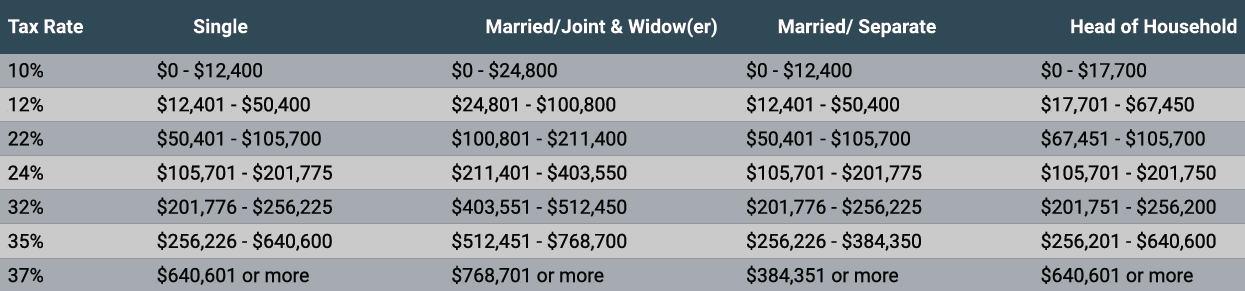
For 2026, there are seven tax rates. They are 10%, 12%, 22%, 24%, 32%, 35%, and 37%. The OBBBA made this rate structure permanent. The income ranges shown below apply to taxable income for the 2026 tax year.
Year-end Tax Planning for 2026

One of our primary goals is to help our clients optimize their tax situations. This report provides various suggestions and reviews strategies that can be useful in achieving this objective.
Since everyone’s situation is unique, it’s important for every taxpayer to start their year-end planning now! The appropriate strategies you use will depend on your income and other personal circumstances. As you go through this report, it may be helpful to note any strategies that seem relevant to your situation so you can discuss them with your tax preparer.
Some items to consider include:
Evaluate the use of itemized deductions versus the standard deduction.
For 2026 tax returns, the standard deduction is $16,100 for single individuals and married couples filing separately, $24,150 for heads of household, and $32,200 for married couples filing jointly and surviving spouses.
The Tax Cuts and Jobs Act (TCJA) roughly doubled the standard deduction back in 2017. Its goal was to decrease tax payments for many of those who typically claim this standard deduction. The OBBBA not only made this deduction increase permanent, but it also slightly increased the deduction amount.
For the 2026 tax year, the additional standard deduction for taxpayers who are age 65 or older, or blind, is $2,050 for unmarried individuals who are not surviving spouses and $1,650 per qualified person for married taxpayers and surviving spouses.
A new senior bonus tax deduction was made available starting in 2025 for eligible individuals aged 65 and older. This bonus deduction allows them to claim an additional deduction of up to $6,000, in addition to the standard deduction and the existing extra deduction for seniors. To fully benefit from the senior bonus, you must meet specific age and income requirements. You must be 65 or older by December 31 of the tax year. This deduction begins to phase out at a 6% rate for modified adjusted gross income (MAGI) above certain thresholds and disappears entirely at higher income levels. For single filers, the full $6,000 deduction is available for MAGI up to $75,000. It phases out completely at $175,000. For married couples filing jointly, the total deduction can reach up to $12,000 if both spouses are 65+ and your MAGI is no greater than $150,000. It reduces and phases out completely at $250,000. It’s important to note that this new deduction is available regardless of whether you itemize deductions or take the standard deduction. Also, please note that it’s a temporary measure and is set to expire after the 2028 tax year.
Although personal exemption deductions are no longer available, the larger standard deduction, combined with lower tax rates and an increased child tax credit, could result in less tax. You should consider running the numbers to assess the impact on your situation before deciding to take itemized deductions.
Consider bunching charitable contributions or using a donor-advised fund.
For taxpayers who are inclined to give to charity, it’s wise to develop a strategic plan. One effective method to maximize the tax benefits of charitable contributions is known as "bunching." This strategy involves consolidating donations and other deductible expenses into specific years, ensuring that your total deductions surpass the standard deduction for those years.
Another strategy is to consider using a donor-advised fund. A donor-advised fund, or DAF, is a philanthropic vehicle established as a public charity. It allows donors to make a charitable contribution, receive an immediate tax benefit, and then issue grants from the fund over time. Taxpayers can arrange their situation to take advantage of the charitable deduction when they’re in a higher marginal tax rate while actual payouts from the donor-advised fund can be deferred until later. It can be a win-win situation. If you are charitably inclined and need some guidance, please call us and we can assist you.
Review your home equity debt interest.
The OBBA made the TCJA provisions for mortgages permanent. For mortgages taken out after October 13, 1987, and before December 16, 2017 (i.e., entered into a binding contract by that date), mortgage interest is fully deductible up to the first $1,000,000 of mortgage debt incurred to acquire or improve a qualified residence. The TCJA lowered the threshold to $750,000 or $375,000 (married filing separately) for homes purchased after December 15, 2017, but before January 1, 2026. The OBBBA permanently locked in the $750,000 limitation for acquisition indebtedness incurred after December 16, 2017.
Interest on home equity lines of credit (HELOCs) and cash-out refinancings may be deductible as well if the funds were used to improve the home that secures the loan (or if the proceeds were invested). Please share with your tax preparer how the proceeds of your home equity loan were used. If you used the cash to pay off credit cards or other personal debts, the interest is not deductible.
Revisit the use of qualified tuition plans.
Qualified tuition plans, also called 529 plans, can help families save tax-efficiently for education. Beginning in 2026, up to $20,000 per beneficiary may be distributed annually for qualified K-12 expenses, including tuition and certain curriculum, instructional materials, tutoring, testing, dual-enrollment fees, and qualifying therapies for students with disabilities. The OBBBA also expanded eligible tax-free distributions to include certain post-secondary credentialing expenses, such as qualified vocational and trade-school programs.
Unlike IRAs, there are no annual contribution limits for 529 plans (note: the gift tax may effectively create a contribution limit). Instead, there are maximum aggregate limits, which vary by plan. Under federal law, 529 plan balances cannot exceed the expected cost of the beneficiary's qualified higher education expenses. Limits vary by state. Some states even offer a state tax credit or deduction up to a certain amount.
Contributions to a 529 plan are considered completed gifts for federal tax purposes, and in 2026 up to $19,000 per donor, per beneficiary, qualifies for the annual gift tax exclusion. Excess contributions generally must be reported on IRS Form 709 and count against the taxpayer’s lifetime estate and gift tax exemption amount ($15 million in 2026).
There is also an option to make a larger tax-free 529 plan contribution, if the contribution is treated as if it were spread evenly over a 5-year period. A lump sum contribution of up to $95,000 ($19,000 x 5) can be made to a 529 plan in 2026. No other gifts can be made to the same beneficiary, however, front-end loading the gift allows for additional tax-free compounding. Parents or grandparents sometimes use this 5-year gift-tax averaging as an estate planning strategy. If you want to explore setting up a 529 plan, call us and we would be happy to assist you.
Maximize your qualified business income deduction (if applicable).
The Section 199A deduction, also known as the Qualified Business Income (QBI) or pass-through deduction, may allow eligible owners of sole proprietorships, partnerships, LLCs, and S corporations to deduct up to 20% of qualified business income. The OBBBA made this deduction permanent and added a $400 minimum deduction for taxpayers with at least $1,000 of qualified business income beginning in 2026. Limitations begin phasing in above $403,500 for married couples filing jointly and $201,750 for most other filers ($201,775 for married filing separately). This piece of the tax code is complicated and would take an entire report to discuss, so we recommend that if you are a business owner, you should talk with a qualified tax professional about how this new Section 199A could potentially work for you.
Consider All of Your Retirement Savings Options for 2026
If you have earned income or are working, you should consider contributing to retirement plans. This is an ideal time to make sure you maximize your intended use of retirement plans for 2026 and start thinking about your strategy for 2027. For many investors, retirement contributions represent one of the smarter tax moves that they can make. Here are some retirement plan strategies we’d like to highlight.
401(k) contribution limits increased. The elective deferral (contribution) limit for employees under the age of 50 who participate in 401(k), 403(b), most 457 plans, and the federal government’s Thrift Savings Plan is $24,500. The catch-up contribution limit for employees aged 50 and over who participate in 401(k), 403(b), most 457 plans, and the federal government’s Thrift Savings Plan remains $8,000 ($32,500 total). Participants ages 60 through 63 may qualify for the higher catch-up limit of $11,250 ($35,750 total). As a reminder, check with your plans for details and these contributions must be made in 2026.
IRA contribution limits increase. The limit on annual contributions to an Individual Retirement Account (IRA) in 2026 is $7,500 for individuals. The additional catch-up contribution limit for individuals aged 50 and over is not subject to an annual cost-of-living adjustment and is $1,100 (for a total of $8,600). IRA contributions for 2026 can be made all the way up to the filing deadline on April 15, 2027.
Higher IRA income limits. The deduction for taxpayers making contributions to a traditional IRA is phased out for singles and heads of household who are covered by a workplace retirement plan and have modified adjusted gross incomes (MAGI) of $81,000 to $91,000. For married couples filing jointly, in which the spouse who makes the IRA contribution is covered by a workplace retirement plan, the income phase-out range is $129,000 to $149,000. For an IRA contributor who is not covered by a workplace retirement plan and is married to someone who is covered, the deduction is phased out in 2026 as the couple’s income reaches $242,000 and completely at $252,000. For a married individual filing a separate return, the phase-out range is $0 to $10,000 for 2026. Please remember that if your earned income is less than your eligible contribution amount, your maximum contribution amount equals your earned income.
Increased Roth IRA income cutoffs. The MAGI phase-out range for taxpayers making contributions to a Roth IRA is $242,000 - $252,000 for married couples filing jointly in 2026. For singles and heads of households, the income phase-out range is $153,000 - $168,000. For a married individual filing a separate return, the phase-out range remains at $0 to $10,000. Please keep in mind that if your earned income is less than your eligible contribution amount, your maximum contribution amount equals your earned income.
Larger saver's credit threshold. The MAGI limit for the saver’s credit (also known as the Retirement Savings Contribution Credit) for low- and moderate-income workers is $80,500 for married couples filing jointly in 2026, $60,375 for heads of household and $40,250 for all other filers.
Be careful of the IRA one rollover rule. Investors are limited to only one rollover from all their IRAs to another in any 12-month period. A second IRA-to-IRA rollover in a single year could result in income tax becoming due on the rollover, a 10% early withdrawal penalty, and a 6% per year excess contributions tax if that rollover remains in the IRA. Individuals can only make one IRA rollover during any 1-year period, but there is no limit on trustee-to-trustee transfers. Multiple trustee-to-trustee transfers between IRAs and conversions from traditional IRAs to Roth IRAs are allowed in the same year. If you are rolling over an IRA or have any questions on IRAs, please call us.
Roth IRA Conversations
Some IRA owners may want to consider converting part or all of their traditional IRAs to a Roth IRA in 2026. This is never a simple or easy decision. Roth IRA conversions can be helpful, but they can also create immediate tax consequences and can bring additional rules and potential penalties. Please remember the extra income from a Roth IRA rollover could affect other areas of your tax planning. It is always best to run the numbers with a qualified professional prior to making the conversion, so you can calculate the most appropriate strategy for your situation. Call us if you would like to review your Roth IRA conversion options.
Capital Gains & Losses
Looking at your investment portfolio can reveal several different tax saving opportunities. Start by reviewing the various sales you have realized so far this year on stocks, bonds, and other investments. Then review what’s left and determine whether these investments have an unrealized gain or loss. (Unrealized means you still own the investment, versus realized, which means you’ve actually sold the investment.)
Know your basis. To determine if you have unrealized gains or losses, you must know the tax basis of your investments, which is usually the cost of the investment when you bought it. However, it gets trickier with investments that allow you to reinvest your dividends and/or capital gain distributions. We will be glad to help you calculate your cost basis.
Consider loss harvesting. If your capital gains are larger than your losses, you might want to do some “loss harvesting.” This means selling certain investments that will generate a loss. You can use an unlimited amount of capital losses to offset capital gains. However, you are limited to only $3,000 ($1,500 if married filing separately) of net capital losses that can offset other income, such as wages, interest and dividends. Any remaining unused capital losses can be carried forward into future years indefinitely.
Be aware of the “wash sale” rule. If you sell an investment at a loss and then buy it right back, the IRS disallows the deduction. The “wash sale” rule says you must wait at least 30 days before buying back the same security to be able to claim the original loss as a deduction. The deduction is also disallowed if you bought the same security within 30 days before the sale. However, while you cannot immediately buy a substantially identical security to replace the one you sold, you can buy a similar security, perhaps a different stock, in the same sector. This strategy allows you to maintain your general market position while utilizing a tax break.
Always double-check your custodian’s reports. If you sold a security in 2026, the custodian firm reports the basis on an IRS Form 1099-B in early 2027. Unfortunately, sometimes there could be problems when reporting your information, so we suggest you double-check these numbers to make sure that the basis is calculated correctly and does not result in a higher amount of tax than you need to pay.
Long-term Capital Gains Tax Rates
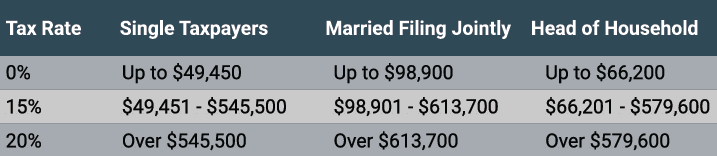
Tax rates on long-term capital gains and qualified dividends changed for 2026. You may qualify for a 0% capital gains tax rate for some or all of your long-term capital gains realized in 2026. In 2026, the 0% rate applies for individual taxpayers with taxable income up to $49,450 on single returns, $66,200 for head of household filers and $98,900 for joint returns. If this is the case, then the strategy is to figure out how much long-term capital gains you might be able to recognize to take advantage of this tax break.
The 3.8% surtax on net investment income stays the same for 2026. It starts for single filers with modified AGI over $200,000 and for joint filers with modified AGI over $250,000.
NOTE: The 0%, 15% and 20% long-term capital gains tax rates only apply to “capital assets” (such as marketable securities) held longer than one year. Anything held for one year or less is considered a “short-term capital gain” and those are taxed at ordinary income tax rates.
Some Notable & Continuing Tax Changes for 2026
The floor for deductible medical expenses is 7.5% for most taxpayers. The 2026 threshold for deducting medical expenses on Schedule A is 7.5% of your 2026 adjusted gross income (AGI). The IRS on IRS.gov provides a long list of expenses that qualify as "medical expenses," so it can be a good idea to keep track of yours if you think you may qualify.
State and local income, sales, and real and personal property taxes (SALT). For 2026, the overall federal itemized-deduction limit is $40,400 ($20,200 if married filing separately). The limit is reduced when MAGI exceeds $505,000 ($252,500 if married filing separately), but it will not fall below $10,000 ($5,000 if married filing separately). The higher cap is scheduled to increase through 2029 and return to $10,000 in 2030. Review the timing and deductibility of SALT payments with your tax preparer.
A new “Trump Account”. This is a tax-advantaged investment account that is prefunded with $1,000 for each child born from the beginning of 2025 through the end of 2028. Children born during this time are eligible for this IRA-like account option. Although children born in 2025 can qualify for this account, Trump accounts became fully functional on July 4, 2026. The goal of this new account is to encourage an early start on saving and investing early in life so that these children have a better opportunity to accrue savings by the time they are ready for larger life expenses, such as college, or the purchase of a home. Please note, there are less complex options for young savers, such as a 529 plan, that also may have greater tax advantages. If this is something you would like to explore, or you would like to explore other options for early jumpstart savings options, please consult with us.
Expanded child tax credit. The child tax credit is up to $2,200 per qualifying child for 2026. This credit is reduced or phased out for single filers with incomes above $200,000 ($400,000 jointly).
A new car interest loan tax deduction. For those of you interested in purchasing a new car, you could get a tax deduction for interest paid on a new car loan. There are parameters for a vehicle to qualify, including that they must be assembled in the United States. This deduction started in 2025 and is set to expire at the end of 2028. This "above-the-line" deduction is capped at $10,000 annually and can be claimed without itemizing. This deduction phases out for higher earners (above $100,000 for single filers and $200,000 for joint filers).
No tax on tips and overtime pay. New provisions in the OBBBA provided tax deductions for tips and overtime pay. These deductions began in 2025 and go through 2028. This is good news for taxpayers in occupations which regularly receive tips, such as waitressing. The deduction for tips received is up to $25,000. Individuals who receive overtime pay that is required only by the Fair Labor Standards Act (FLSA) that exceeds their regular pay are also entitled to a new deduction. This deduction is capped at $12,500 ($25,000 for joint filers). Both of these provisions are phased out for earners making over $150,000 ($300,000 filing jointly).
Education Planning
Education benefits. The student loan interest deduction, education credits, exclusion for savings bond interest, tuition waivers for graduate students, and the educational assistance fringe benefit are all still available in 2026. 529 plan funds can be used to pay for fees, books, supplies and equipment for certain apprenticeship programs. In addition, up to $10,000 in total (not annually) can now be withdrawn from 529 plans to pay off student loans.
The 2026 lifetime learning credit allows you to claim 20% of your out-of-pocket costs for tuition, fees and books, for a total of up to $2,000 as a tax credit. It phases out for couples filing jointly from $160,000 to $180,000 and from $80,000 to $90,000 for singles.
Charitable Giving
Send cash donations to your favorite charity by December 31, 2026. Be sure to hold on to your canceled check or credit card receipt as proof of your donation. If you contribute $250 or more, you also need written acknowledgment from the charity. If you plan to make a significant gift to charity this year, consider gifting appreciated stocks or other investments that you have owned for more than one year. Doing so boosts the savings on your tax returns. Your charitable contribution deduction is the fair market value of the securities on the date of the gift, not the amount you paid for the asset and therefore you avoid having to pay taxes on the profit.
Do not donate investments that have lost value. It is best to sell the asset with the loss first and then donate the proceeds, allowing you to take both the charitable contribution deduction and the capital loss. Also, remember, if you give appreciated property to charity, the unrealized gain must be long-term capital gains in order for the entire fair market value to be deductible. (The amount of the charitable deduction must be reduced by any unrealized ordinary income, depreciation recapture and/or short-term gain.)
The law allowing taxpayers age 70½ and older to make a Qualified Charitable Distribution (QCD) in the form of a direct transfer of up to $111,000 for individuals directly from their IRA over to a charity, including all or part of the required minimum distribution (RMD) was made permanent in 2015. If you meet the qualifications to utilize this strategy, the funds must come out of your IRA by December 31, 2026. Please call us if this is a strategy you are interested in considering.
This is a great time of year to clean your garage or house and give your items to charity. Please remember that you can only write off donations to a charitable organization if you itemize your deductions. Sometimes, your donations can be difficult to value. You can find estimated values for your donated items through a value guide offered by Goodwill at www.goodwillnne.org/donate/donation-value-guide/
Lastly, it’s important for you to be aware of the three new OBBBA tax provisions that could affect charitable giving strategies which became effective starting on January 1, 2026:
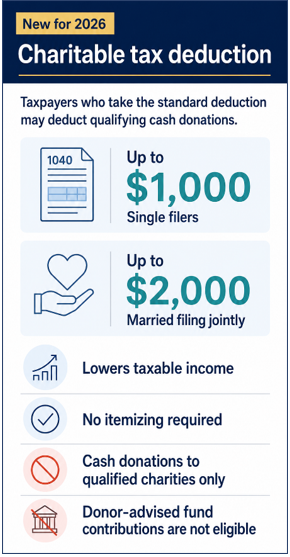
- A reinstated deduction allows non-itemizers to deduct cash donations to charity ($1,000 for single filers or $2,000 for married couples filing jointly). Please note that some types of donations are ineligible for the deduction, including to donor-advised funds (DAFs) or private non-operating foundations.
- The OBBBA caps the tax benefits of itemized charitable deductions at 35%, even for those in the 37% marginal tax bracket. This means that for high-income filers donating $1,000, they would receive a $350 tax benefit instead of the current $370.
- Itemizers who make charitable contributions will only be able to claim a tax deduction should their qualified contributions exceed 0.5% of their adjusted gross income (AGI). For example, a couple with an AGI of $200,000 could only deduct charitable donations in excess of $1,000.
Additional Year-end Tax Strategies & Ideas
Make use of the annual gift tax exclusion. You may gift up to $19,000 tax-free to each donee in 2026. These “annual exclusion gifts” do not reduce your $15 million lifetime gift tax exemption. This annual exclusion gift is doubled to $38,000 per donee for gifts made by married couples of jointly held property or when one spouse consents to "gift-splitting" for gifts made by the other spouse.
Help someone with medical or education expenses. There are opportunities to give unlimited tax-free gifts when you pay the provider of the services directly. Medical expenses must meet the definition of deductible medical expenses. Qualified education expenses are tuition, books, fees, and related expenses, but not room and board. You can find the detailed qualifications in IRS Publications 950 and the instructions for IRS Form 709 at www.irs.gov.
Make gifts to trusts. These gifts often qualify as annual exclusion gifts ($19,000 in 2026 for individuals) if the gift is direct and immediate. A gift that meets all the requirements removes the property from your estate. The annual exclusion gift can be contributed for each beneficiary of a trust. We are happy to review the details with your estate planning attorney.
Estate, Gift, & Generation-Skipping Tax Changes
For 2026, the federal estate, gift, and generation-skipping transfer tax exemption is $15 million per individual ($30 million for a married couple, subject to applicable portability and planning rules). Transfers above the available exemption may be subject to a 40% federal tax rate. This high amount provides high-net-worth individuals a significant planning window to make gifts and set up irrevocable trusts. Prior to the OBBBA passing into law, the estate tax exclusion was due to revert to pre-2018 levels. The OBBBA made the higher exemption permanent and provides for inflation adjustments. The income-tax basis adjustment to fair market value at death generally remains in place, making the best tax planning for most families to avoid large gifts of appreciated property during life.
Conclusion
One of our primary goals is to keep clients aware of tax law changes and updates. This report is not a substitute for using a tax professional. Please note that many states do not follow the same rules and computations as the federal income tax rules. Make sure you check with your tax preparer to see what tax rates and rules apply for your state.
There are many other additional tax reduction strategies that will vary depending on your financial picture. We encourage you to come in so that we can review your situation and hopefully take advantage of those tax rules that apply to you.
2026 Year-end Tax Planning Checklist
A "Proactive" approach to your tax planning stead of a "Reactive" approach could produce better results! If you need assistance reviewing any of these items prior to year-end, please call us and we'd be happy to help you!
- Bracket Management
- Itemized Deduction Timing
- Gain & Loss Harvesting
- Retirement Planning
- Education Planning
- Charitable Planning
- Gifting Strategies
- Estate Tax Planning
- Planning for Major Financial or Life Events or Any Other Personal Situation Concerns
We are accepting new clients!
- Do you feel your advisor is fully aware of your financial situation?
- Has your advisor reviewed your tax forms?
- Has your advisor discussed tax planning strategies that could help you keep more of what you make?
- Is your advisor updated and current on tax planning strategies?
- Would you like a complimentary review of your financial situation?
If you answered No or Not Sure to any of these questions, we would like to offer you a complimentary, one-hour, private consultation with one of our professionals. To schedule your financial consultation, please call us at (714) 597-6510.
Upcoming Events
- Investments Webinar | Wed, Oct 7 at 6pm PT
- Property Inheritance Webinar | Wed, Oct 14 at 6pm PT
- Social Security & Medicare Webinar | Wed, Oct 21 at 6pm PT
- Understanding Dementia & Alzheimer's Disease Webinar | Wed, Oct 28 at 6pm PT
- Tax Planning & Update Webinar | Wed, Nov 4 at 6pm PT
Click HERE to learn more about our upcoming events.
Financial Advisors Network, Inc. is a registered investment advisory firm. Note: The views stated in this letter are not necessarily the opinion of Financial Advisors Network, Inc. and should not be construed, directly or indirectly, as an offer to buy or sell any securities mentioned herein. Information is based on sources believed to be reliable; however, their accuracy or completeness cannot be guaranteed. Please note that statements made in this newsletter may be subject to change depending on any revisions to the tax code or any additional changes in government policy. Please note that individual situations can vary. Unless certain criteria are met, Roth IRA owners must be 59½ or older and have held the IRA for five years before tax-free withdrawals are permitted. Additionally, each converted amount is subject to its own five-year holding period. Investors should consult a tax advisor before deciding to make a conversion.
Rules and laws governing 529 plans are varied and subject to change. As with other investments, there are generally fees and expenses associated with participation in a 529 plan. There is also a risk that these plans may lose money or not perform well enough to cover college costs as anticipated. Most states offer their own 529 programs, which may provide advantages and benefits exclusively for their residents. Investors should consider, before investing, whether the investor's or the designated beneficiary's home state offers any tax or other benefits that are only available for investment in such state's 529 college savings plan. Such benefits include financial aid, scholarship funds, and protection from creditors. The tax implications can vary significantly from state to state. Tax laws and provisions may change at any time. Death of the contributor prior to the end of the five-year period may result in a portion of the contribution to be included in the contributor’s estate. Please consult a qualified tax professional to discuss tax matters. Source: irs.gov. Contents provided by the Academy of Preferred Financial Advisors, Inc. Reviewed by Keebler & Associates. © Academy of Preferred Financial Advisors, Inc. 2026
Turn Bulletins into Action
Stay informed—then come in for a free consultation and see how the updates apply to your financial life.