
Q1 2026 Tax Report
Tax planning should always be a key focus when reviewing your personal financial situation. One of our goals as financial professionals is to identify as many tax saving opportunities and strategies as possible for our clients. We believe that a proactive approach to looking at your tax situation can lead to better results than a reactive approach. We hope you find this report helpful.
This special report reviews some of the broader tax laws along with a wide range of tax reduction strategies. As you read this report, please take note of each tax strategy that you think could be beneficial to you. Not all ideas are appropriate for all taxpayers. We always recommend that you address any tax strategy with your tax professional to consider how one strategy may affect another and calculate the income tax consequences (both state and federal). Remember, tax strategies and ideas that have worked in the recent past might not even be available under today’s new tax laws. Always attempt to understand all the details before making any decisions—it is always easier to avoid a problem than it is to solve one.
Please note: Your state income tax laws could be different from federal income tax laws. Visit https://tax.findlaw.com for a wide range of information and links to tax forms for all 50 states. All examples mentioned in this report are hypothetical and meant for illustrative purposes only.
Income tax is a large revenue source for the United States government. While tax rates have changed many times, the United States has used a “progressive” tax code. A progressive tax code means that people who make more money are taxed at a higher rate than those who make less money. Our progressive tax system works by placing earners through different brackets according to how much money they make. The dollar amounts define your tax brackets and there are differing tables depending on your filing status (single, married, etc.). This matters in determining your marginal tax rate.
Understanding Marginal Tax Rates
Determining your tax bracket is not as simple as just adding up your total income and checking a tax table. Taxpayers need to calculate their income (which can be sometimes referred to as their “adjusted gross income”) and then adjust for any deductions to find their final taxable amount.
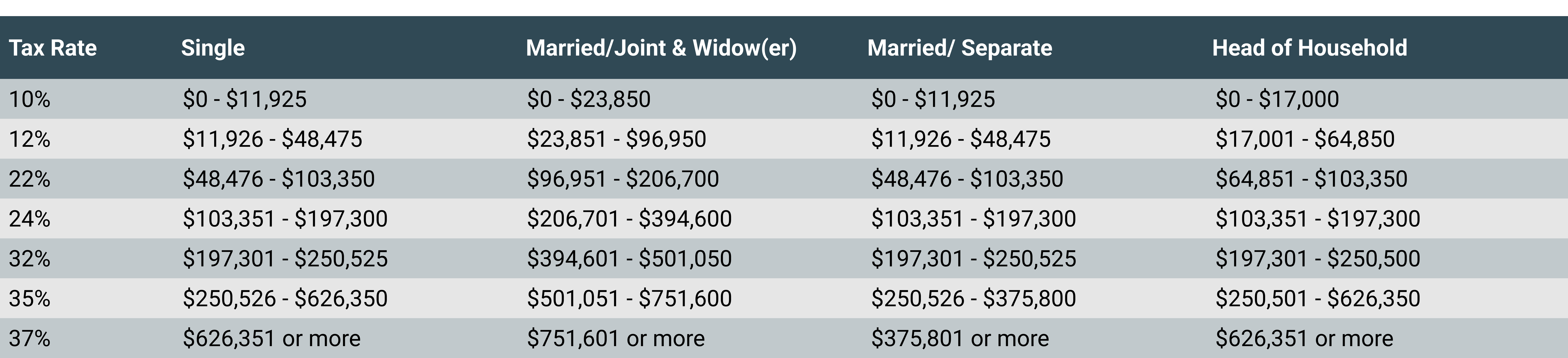
Once you determine your taxable income amount, it is critical to know that your income will be taxed at different rates. For example, if someone is married filing jointly in 2025 with $105,000 of taxable income, their first $23,850 is taxed at 10%, then $73,100 at 12%, and $8,050 at 22%. An important concept to understand is that these tax filers were in a “marginal tax bracket” of 22%. That is, their last dollar earned was taxed at that 22% tax rate.
2025 Tax Law Updates
2025 brought a number of tax legislation changes. While there is time to investigate tax planning ideas for your 2026 taxes, here are some items that 2025 tax filers should review.
- Tax brackets have been slightly adjusted.
- Standard deductions have slightly increased.
- The cap on state and local tax (SALT) deductions has been expanded starting in 2025.
- Long-term capital gains are still taxed at favorable rates.
- There is still a 3.8% Net Investment Tax.
- Charitable donations are available to those who can itemize deductions.
- A new senior deduction was added starting in 2025.
- An Auto Loan interest deduction was added starting in 2025.
- No tax on Tips and No Tax on Overtime deductions were added starting in 2025.
- Medical expenses are deductible only to the extent they exceed 7.5% of AGI for 2025.
New Tax Laws Are Here!
Recent federal tax legislation, including the One Big Beautiful Bill Act, introduced several updates to the tax code. Some provisions took effect beginning in 2025, while others are scheduled to begin in 2026. Our goal is to help keep you informed about changes that may impact your personal tax situation and planning opportunities.
2025 Tax Tables and Tax Rates
There are seven federal income tax brackets for 2025. The lowest of the seven tax rates is 10% and the top tax rate is still 37%. The income that falls into each is scheduled to be adjusted in 2026 for inflation. For 2025, use the chart in this report to see what bracket your final income fell into.
TAX TIP: If you are not sure how best to file, ask your tax preparer or review IRS Publication 17, Your Federal Income Tax, which is a complete tax resource. It contains helpful information such as whether you need to file a tax return and how to choose your filing status.
2025 Standard Deduction Amounts
Most taxpayers claim the standard deduction. For 2025, the standard deduction has slightly increased. The amounts are now $15,000 for single filers and $30,000 for those filing jointly ($22,500 for head of household filers). If you are filing as a married couple, an additional $1,600 is added to the standard deduction for each spouse age 65 and older ($2,000 if you are single).
New Senior Deduction
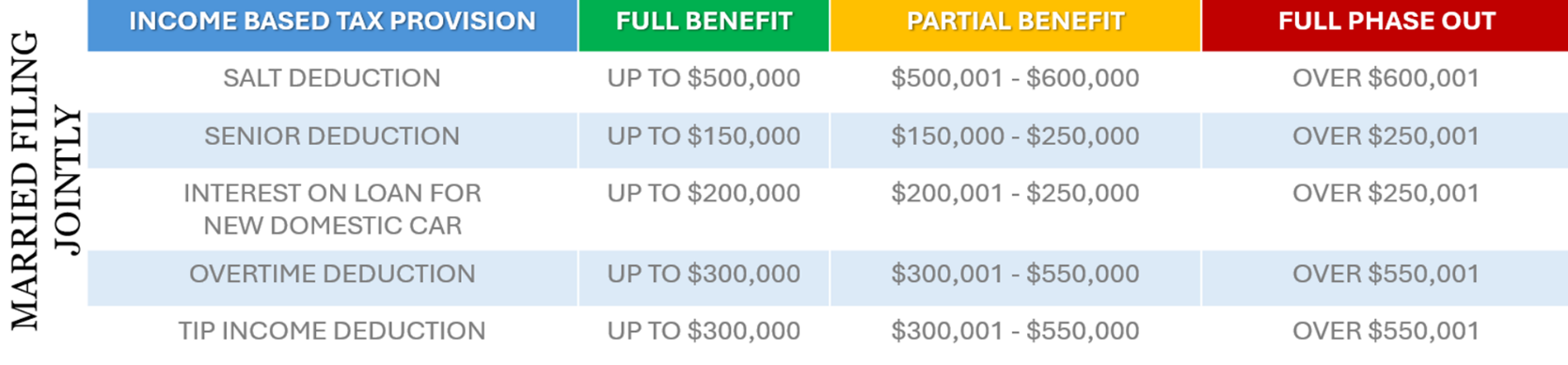
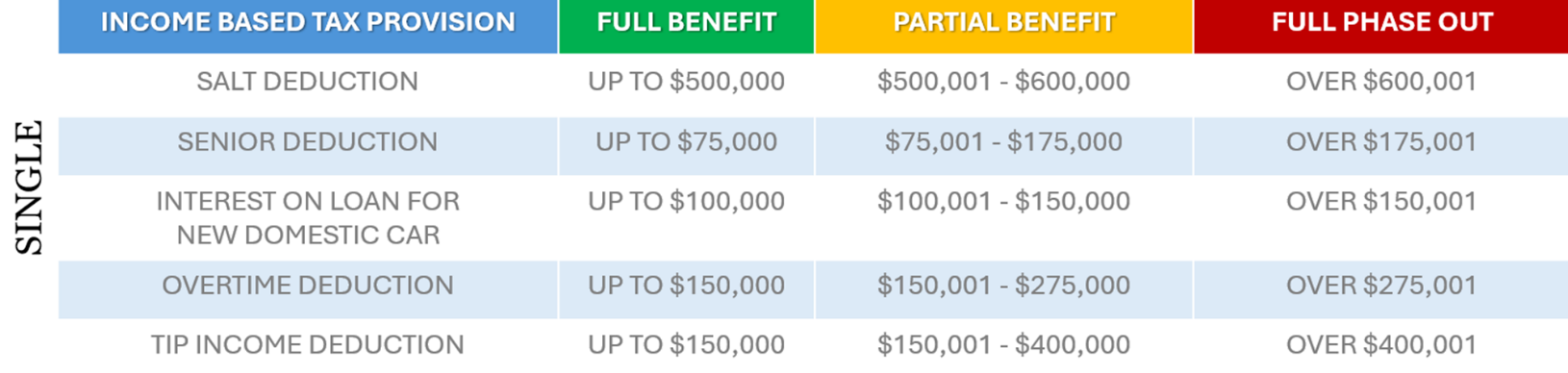
The One Big Beautiful Bill Act (OBBBA), signed into law in July 2025, created a new senior tax deduction that lets most taxpayers age 65 and older claim an additional deduction of up to $6,000 (or up to $12,000 for married couples filing jointly) on their federal tax returns for tax years 2025 through 2028. This extra deduction is in addition to the regular standard deduction and existing age-based deduction, and it gradually phases out for higher-income seniors (beginning at $75,000 MAGI for single filers and $150,000 MAGI for married joint filers). The goal is to reduce taxable income for older Americans, potentially boosting refunds or lowering tax bills, through 2028.
Child Tax Credit
The 2025 "One Big Beautiful Bill Act" (OBBBA) has permanently enhanced the Child Tax Credit (CTC) to $2,200 per child (up from $2,000) for children under 17, with adjustments for inflation starting in 2026. The income phase-out thresholds for the CTC remain $200,000 for single filers and $400,000 for joint filers.
State and Local Tax (SALT) Deduction
The 2017 Tax Cuts and Jobs Act (TCJA) capped state and local tax deductions (SALT) at $10,000 ($5,000 for married taxpayers filing separately). The One Big Beautiful Bill Act significantly increased this cap to $40,000 with a 1% increase in the cap each year through 2029 before returning to the $10,000 limit for 2030. The $40,000 deduction cap is phased down to the prior $10,000 cap for taxpayers with a modified adjusted gross income (MAGI) over $500,000. The phase-down occurs over a $100,000 range and therefore taxpayers with a MAGI of $500,000 or more are limited to a SALT deduction of $10,000. It is always helpful to review your SALT payments and their potential deductibility with your tax preparer.
Medical Expense Deduction
The 2025 threshold for deducting medical expenses remained at 7.5% of your AGI. You must itemize your deductions to deduct these medical expenses. The IRS website, www.IRS.gov, provides a long list of expenses that qualify as "medical expenses," so it can be a good idea to keep track of yours if you think they may qualify.
New “No Tax on Tips” Provision
The “no tax on tips” provision in the One Big Beautiful Bill Act creates a temporary federal income tax deduction for qualified tip income earned in occupations that traditionally and customarily receive tips. For tax years 2025 through 2028, eligible workers can deduct up to $25,000 of reported tips from their taxable income, reducing their federal income tax liability, with a phase-out for higher earners above certain income thresholds. However, tips still must be reported and remain subject to Social Security and Medicare (payroll) taxes, and state income taxes may still apply.
Investment Income
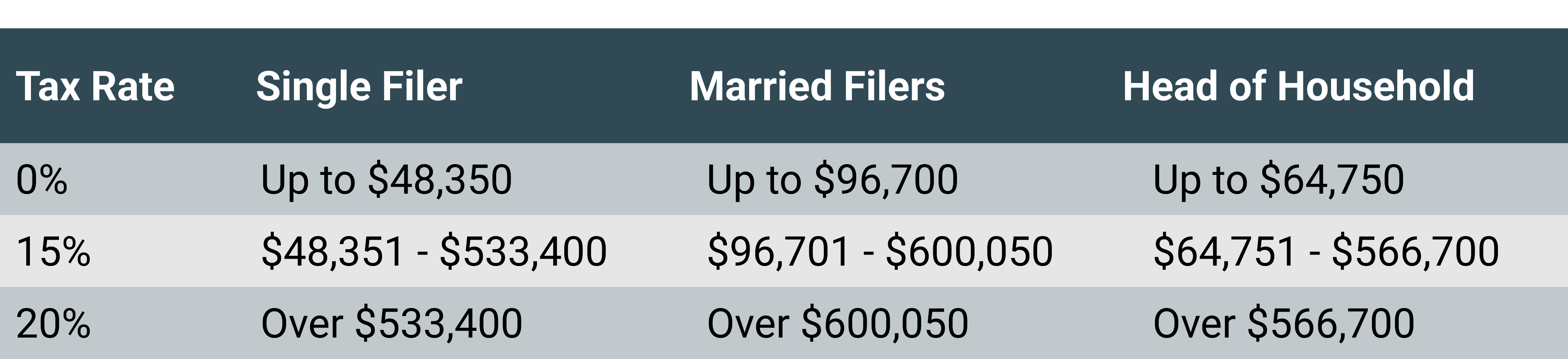
Long-term capital gains are taxed at more favorable rates compared to ordinary income. For qualified dividends, investors will continue to be taxed at 0, 15% or 20%.
One tax strategy is to review your investments with unrealized long-term capital gains and sell enough of the appreciated investments to generate enough long-term capital gains to push you to the top of your federal income tax bracket. This strategy could be helpful if you are in the 0% capital gains bracket and do not have to pay any federal taxes on this gain. Then, if you want, you can buy back your investment the same day, increasing your cost basis in those investments. If you sell them in the future, the increased cost basis will help reduce long-term capital gains. You do not have to wait 30 days before you buy back this investment—the 30-dayrule only applies to losses, not gains.
Note: This non-taxable capital gain for federal income taxes might not apply to your state.
TAX TIP: Remember that marginal tax rates on long-term capital gains and dividends can be higher than expected. The 3.8% surtax can raise the effective rate to 18.8% for single filers with income from $200,000 to $533,400and 23.8% for single filers with income above $533,400 in 2025. It can raise the effective rate to 18.8% for married taxpayers filing jointly with income from $250,000 to $583,750 and to 23.8% for married taxpayers filing jointly with income above $583,750.
Calculating Capital Gains and Losses
With the different tax rates for different types of gains and losses in your marketable securities portfolio, it is probably a good idea to familiarize yourself with some of the ordering rules:
- Short-term capital losses must first offset short-term capital gains.
- Long-term capital losses must first offset long-term capital gains.
- If there are net short-term losses, they can be used to offset net long-term capital gains.
- If there are net long-term losses, they can be used to offset net short-term capital gains.
- If all gains and losses net to an overall loss, up to $3,000 can offset ($1,500 if married filing separately) ordinary income.
- Remaining unused capital losses can be carried forward to later tax years and then considered in the same manner as described above.
TAX TIP: Please remember to look at your 2024 income tax return Schedule D (page 2) to see if you have any capital loss carryover from 2024. This is often overlooked, especially if you are changing tax preparers.
Please double-check your capital gains or losses. If you sold an asset outside of a qualified account during 2025, you most likely incurred a capital gain or loss. Sales of securities showing the transaction date and sale price are listed on the 1099 generated by the financial institution. However, your 1099 might not show the correct cost basis or realized gain or loss for each sale. You will need to know the full cost basis foreach investment sold outside of your qualified accounts, which is usually what you paid for it, but this is not always the case.
3.8% Medicare Investment Tax
The Net Investment Income Tax (NIIT) is a 3.8% Medicare surtax that has been in effect since 2013. It applies to higher-income taxpayers who earn investment income. If you earn more than $200,000 as a single or head of household taxpayer, $125,000 as married taxpayers filing separately or $250,000 as married joint return filers, then this tax applies to either your modified adjusted gross income or net investment income (including interest, dividends, capital gains, rentals, and royalty income), whichever is lower. This 3.8% tax is in addition to capital gains or any other tax you already pay on investment income.
Because NIIT is sensitive to income levels, timing can be especially important if your income fluctuates or is close to the threshold. In some cases, realizing capital gains in lower-income years may help reduce or avoid the surtax. The inclusion limits may penalize married couples, so realizing investment gains before you tie the knot may help in some circumstances. This tax can also make strategies such as depreciation, installment sales, and other tax deferral approaches more attractive for certain taxpayers.
Medicare Health Insurance Tax on Wages
If you earn more than $200,000 in wages or self-employment income ($250,000 if filing jointly, or $125,000 if married filing separately), the Affordable Care Act imposes an additional 0.9% Medicare tax on earned income above these thresholds. You’ll pay this all year as your employer withholds the additional Medicare Tax from your paycheck. If you’re self-employed, plan for this tax when you calculate your estimated taxes.
If you’re employed, there’s little you can do to reduce the bite of this tax. Requesting non-cash benefits in lieu of wages won’t help—they’re included in the taxable amount. If you’re self-employed, you may want to take special care in timing income and expenses (especially depreciation) to avoid the limit.
Charitable Gifts and Donations
For 2025, the rules remain that taxpayers can only deduct charitable contributions if they itemize their tax deductions on Schedule A. The 60% of AGI ceiling on charitable cash contributions was made permanent by the One Big Beautiful Bill Act.
To qualify for the 60% limitation, the charitable gift must be cash (or cash equivalent) made to a qualified charity (501(c)(3)). To qualify, this contribution should have been made on or before December 31, 2025.
When preparing your list of charitable gifts, remember to review your bank account so you do not leave any out. Everyone remembers to count the monetary gifts they make to their favorite charities, but you should count noncash donations as well. Make it a priority to always get a receipt for every gift. Keep your receipts. If your contribution totals more than $250, you will also need an acknowledgment from the charity documenting the support you provided. Remember that you will have to itemize to claim this deduction, but when filing, the expenses incurred while doing charitable work often are not included on tax returns.
You can’t deduct the value of your time spent volunteering, but if you buy supplies fora group, the cost of that material is deductible as an itemized charitable donation. You can also claim a charitable deduction for the use of your vehicle for charitable purposes, such as delivering meals to the homebound in your community or taking your child’s Scout troop on an outing. For 2025, the IRS will let you deduct that travel at .14 cents per mile.
Child and Dependent Care Credit
Millions of parents claim the child and dependent care credit each year to help cover the costs of after-school daycare while working. Some parents overlook claiming the tax credit for childcare costs during the summer. This tax break can also apply to summer day camp costs. The key is that for deduction purposes, the camp can only be a day camp, not an overnight camp.
In 2025, if you paid a daycare center, babysitter, summer day camp, or other care provider to care for a qualifying child under age 13 or a disabled dependent of any age, you may qualify for the Child and Dependent Care Tax Credit. Depending on your income, the credit is worth 20% to 35% of qualifying expenses, up to $3,000 of expenses for one qualifying individual, or $6,000 for two or more.
Contribute to Retirement Accounts
The SECURE Act eliminated the age limit for Traditional IRA contributions, allowing individuals with earned income to continue contributing to a Traditional IRA past age 70½ beginning in 2020.
If you have not already funded your retirement account for 2025, consider doing so by Wednesday, April15, 2026, which is the deadline for contributions to a Traditional IRA(deductible or nondeductible) and a Roth IRA for the 2025 tax year.
However, if you have a SEP IRA or Keogh plan and obtain a filing extension until October 15, 2026, you may generally wait until then to make your 2025 contributions. However, to take advantage of tax-advantaged growth as soon as possible, it may be beneficial not to delay funding these accounts. If eligible, a deductible Traditional IRA contribution may help reduce your 2025 tax bill, and your retirement savings can grow tax-deferred.
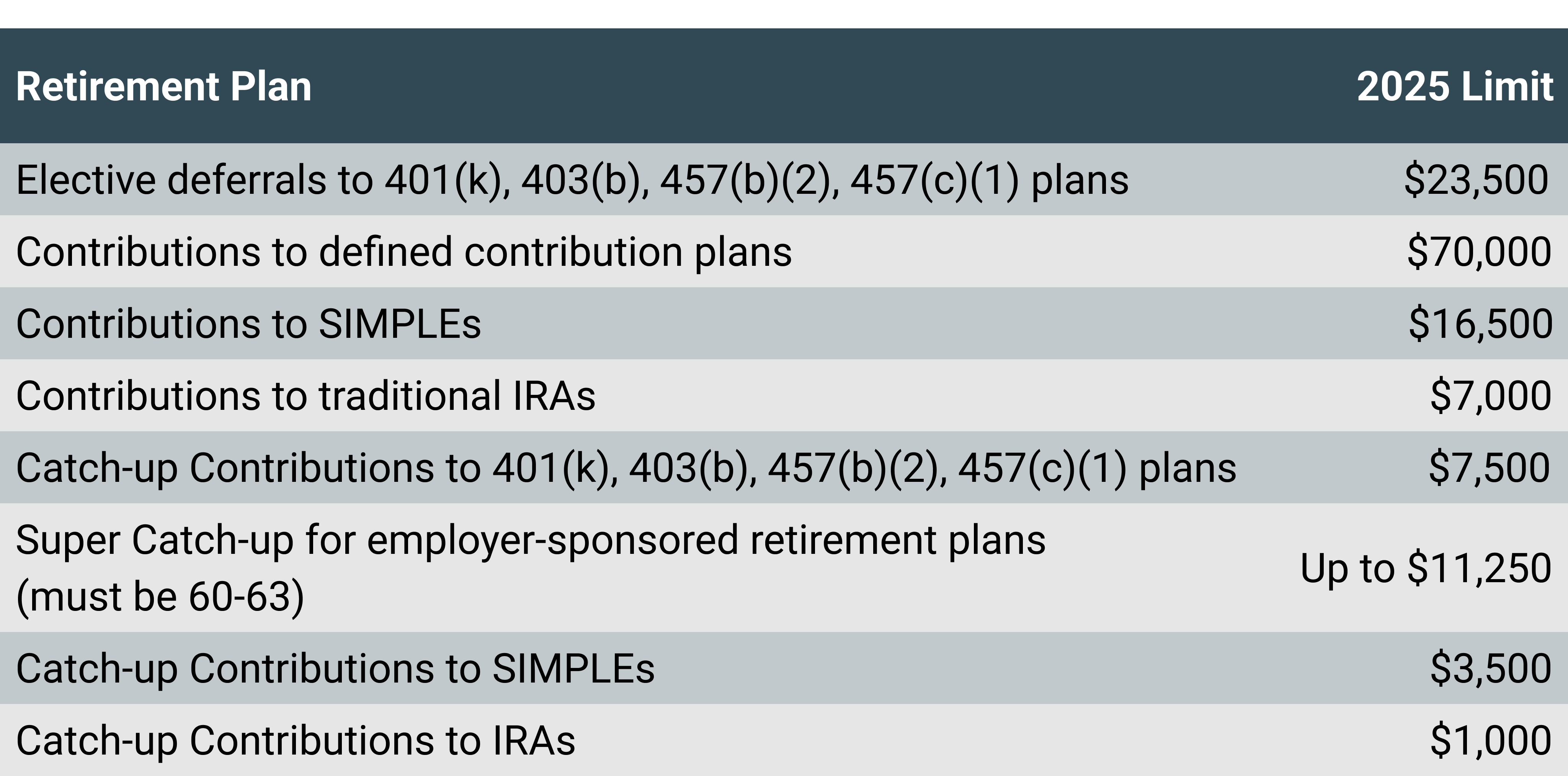
To qualify for the full annual IRA deduction in 2025, you must either: 1) not be eligible to participate in a company retirement plan, or 2) if you are eligible, there is a phase-out from $79,000 to $89,000 of MAGI for singles and from $126,000 to $146,000 for married taxpayers filing jointly. If you are not eligible for a company plan but your spouse is, your traditional IRA contribution deduction is phased out from $230,000 to $240,000. For 2025, the maximum IRA contribution you can make is $7,000 ($8,000 if you are age 50 or older by the end of the calendar year). For self-employed persons the maximum annual addition to SEPs and Keoghs for 2025 is $70,000.
Although contributing toa Roth IRA instead of a traditional IRA will not reduce your 2025 tax bill(Roth contributions are not deductible), it could be the better choice because all qualified withdrawals from a Roth can be tax-free in retirement. Withdrawals from a traditional IRA are fully taxable in retirement. To contribute the full $7,000 ($8,000 if you are age 50 or older by the end of 2025) to a Roth IRA, you must have MAGI of $150,000 or less a year if you are single or $236,000 if you are married and file a joint return. If you have any questions on retirement contributions, please call us.
In 2025, New “Super Catch-up contributions” from the SECURE 2.0 Act Allows those aged 60 to 63 who are participants of some retirement plans to make “super-catch-up contributions” of up to $11,250. Beginning in 2026 those with higher incomes will have to make these as ROTH 401k contributions.
Roth IRA Conversions
A Roth IRA conversion is when you convert part or all of your traditional IRA into a Roth IRA. This is a taxable event. The amount you converted is subject to ordinary income tax. It might also cause your income to increase, thereby subjecting you to surtaxes. Roth IRAs grow tax-free and qualified withdrawals are tax-free in the future, a time when tax rates might be higher
Whether to convert part or all of your traditional IRA to a Roth IRA depends on your particular situation. It is best to prepare a tax projection and calculate the appropriate amount to convert. Remember—you do not have to convert all of your IRA to a Roth. Roth IRA conversions are not subject to the pre-age 59½ penalty of 10%.
Many 401(k) plan participants (if their plan allows) can convert the pre-tax money in their401(k) plan to a Roth 401(k) plan without leaving the job or reaching age 59½.There are numerous pros and cons to making this change. Please call us to see if this makes sense for you.
Required Minimum Distributions (RMD)
The SECURE Act increased the age for Required Minimum Distributions (RMD) starting January 1, 2020, to age 72. The SECURE 2.0 Act increased the age to start taking RMDs further, to 73 in 2023 and to 75 in 2033. For the purposes of tax year 2025, the Required Minimum Distributions age is 73
Overlooked Tax Items and NEW Deductions
Reinvested Dividends - This is not a tax deduction, but it is an important calculation that can save investors a bundle. Many investors have mutual fund dividends that are automatically used to buy extra shares. Remember that each reinvestment increases your tax basis in that fund. That will, in turn, reduce the taxable capital gain (or increases the tax-saving loss) when you redeem shares. Please keep good records. Forgetting to include reinvested dividends in your basis results in double taxation of the dividends—once in the year when they were paid out and immediately reinvested and later when they are included in the proceeds of the sale.
If you are not sure what your basis is, ask the fund or us for help. Funds often report to investors the tax basis of shares redeemed during the year. Regulators currently require that for the sale of shares purchased, financial institutions must report the basis to investors and to the IRS.
Student-Loan Interest Paid by Parents – In general, you can deduct interest only if you are legally required to repay the debt. But, if parents pay back a child's student loans, the IRS treats the transactions as if the money were given to the child, who then paid the debt. So, as long as the child is no longer claimed as a dependent, the child can deduct up to $2,500 of student-loan interest paid by their parents each year and is subject to income limitations. (The parents can't claim the interest deduction even though they actually foot the bill because they are not liable for the debt).
New auto loan deduction -The One Big Beautiful Bill Act states in tax years 2025 to 2028, there is a new federal tax deduction that lets individual taxpayers deduct up to $10,000 per year of interest paid on qualifying personal auto loans on their federal tax return—even if they don’t itemize. To qualify, the loan must be for a new vehicle purchased after Dec. 31, 2024, the vehicle must be for personal use and have undergone final assembly in the United States, and the loan must be secured by a lien on the vehicle. The deduction applies through tax year 2028 and phases out for higher-income taxpayers (beginning around $100,000 MAGI for single filers and $200,000 for joint filers).
Other Helpful Tax Time Strategies
- Write down expenses or keep all receipts you think are even possibly tax-deductible. Sometimes, taxpayers assume that various expenses are not deductible and therefore do not mention them to their tax preparer. Don’t assume anything—give your tax preparer the chance to tell you whether something is or is not deductible.
- Be careful not to overpay Social Security taxes. If you received a paycheck from two or more employers and earned more than $176,100 in 2025, you may be able to file a claim on your return for the excess Social Security tax withholding.
- Don’t forget items carried over from prior years because you exceeded annual limits, such as capital losses, passive losses, charitable contributions, and alternative minimum tax credits.
- Check your 2024 tax return to see if there was a refund from 2024 applied to 2025 estimated taxes
- Calculate your estimated tax payments for 2026 very carefully. Many computer tax programs will automatically assume that your income tax liability for the current year is the same as the prior year. This is done to avoid paying penalties for underpayment of estimated income taxes. However, in some cases, this might not be a correct assumption, especially if 2025 was an unusual income tax year due to the sale of a business, unusual capital gains, the exercise of stock options, or even winning the lottery! A qualified tax professional should be able to help you with a tax projection for 2026.
- Remember that IRS.gov could be a valuable online resource for tax information.
- Always double check your math where possible and remember it is always wise to consult a tax preparer before filing.
Proactive Tax Planning for 2026
A “Proactive” approach to your tax planning instead of a “Reactive” approach could produce better results!
Items Taxpayers May Consider for Proactive 2026 Tax Planning Include:
- Prepare a 2026 tax projection - Taxpayers already know the 2026 rates and by reviewing their 2025 situation and all 2026 expectations of income, a qualified tax professional could help them with a tax projection for 2026.
- New contribution limits for retirement savings - For 2026, the contribution limit for employees who participate in 401(k), 403(b), most 457 plans, and the federal government's Thrift Savings Plan is $24,500. The limit on annual contributions to an IRA is $7,500. The catch-up contribution limits for those 50 and over increases slightly to $1,100 for IRAs.
- Explore if a potential Roth IRA conversion is helpful for your situation - A Roth IRA can be beneficial in your overall retirement planning. Investments in a Roth IRA have the potential to grow tax-free and they do not have required minimum distributions during the lifetime of the original owner. Also, Roth IRA assets may pass to your heirs income tax-free. Roth conversions include complex details and are not right for everyone. Also, some recent proposals have suggested changes about which IRAs could be converted to ROTH IRAs. For updates and to review if a ROTH conversion is a good idea for you, please call us.
- Take advantage of annual exclusion gifts - For 2026, the maximum amount of gift tax exemption remains at $19,000 for gifts made by an individual and $38,000 for gifts made by married couples. This means you can give up to that amount to a family member without having to pay a gift tax. Ideas for gifting can include contributing to a working child (or grandchild’s) IRA or gifting to a 529 plan, which is a tax-sheltered plan for college expenses.
- Consider bunching your charitable donations into a Donor Advised Fund (DAF) - Now is the time to explore if it is helpful for your tax situation to deposit cash, appreciated securities or other assets in a Donor Advised Fund, and then distributing the money to charities over time. Up to 60% of your adjusted gross income can be deductible if given as donations to typical charities.
- For 2026, the maximum Qualified Charitable Distribution (QCD) is $111,000 per individual. This means that someone aged 70 1/2 or older can donate up to $111,000 directly from their IRA to a qualified charity without having to include the amount in their taxable income.
- Talk with us about your situation. We appreciate the opportunity to be the stewards of our client’s wealth.
The One Big Beautiful Bill Act
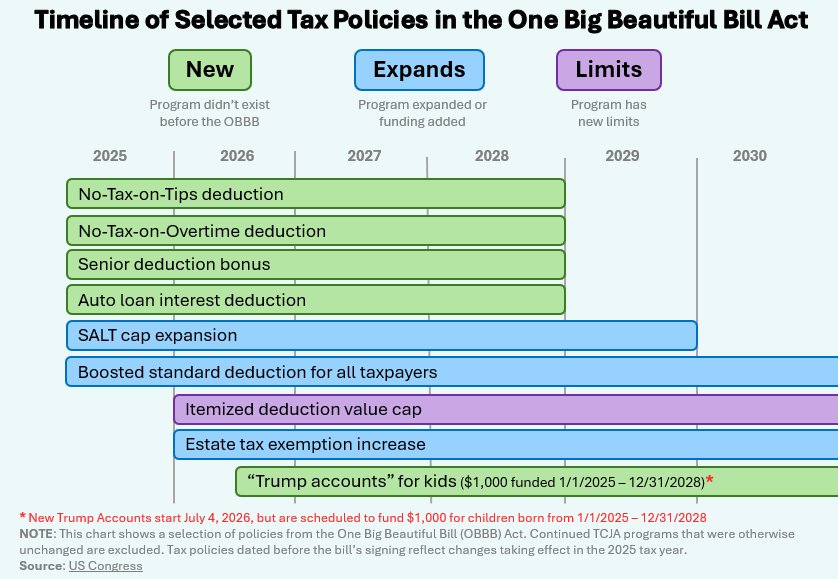
The One Big Beautiful Bill Act brought many changes to tax law rules.
Some of these changes start for tax year 2025, others for tax year 2026. Many of them also have limitations and expiration dates. Here are some tables of several of the more popular tax policies for informational purposes. Always remember to review this and all your specific tax information with your tax preparer.
Conclusion
Tax law rules and guidelines can be very complicated and sometimes confusing. WWW.IRS.GOV can be a great resource if you have questions. Filing your 2025 taxes will continue to include the new tax rates set forth by the TCJA and made permanent by the OBBBA. While there are many tax laws and rules this report covers some rules and ideas we thought clients would find helpful. We still feel an essential part of maintaining your overall financial health is attempting to keep your tax liability to a minimum.
One of our primary goals is to keep you informed of the changes that will be affecting investors like you. We believe that taking a proactive approach is better than a reactive approach— especially regarding income tax strategies!
None of the information in this report is intended to be a substitute for specific individualized tax, legal or investment planning advice. We suggest that you discuss your specific tax issues with a qualified tax advisor.
If you would like us to review your financial situation, we would be happy to do so. We pride ourselves in our ability to help clients make informed decisions.
We’re here to help, because we don’t want you to worry about things that you don’t need to worry about!
We are accepting new clients
- Do you feel your advisor is fully aware of your financial situation?
- Are you satisfied with how your advisor is keeping you updated?
- Has your advisor reviewed your tax forms to understand how to coordinate your investments with your taxes?
- Has your advisor discussed tax planning strategies that could help you keep more of what you make>
- Is your advisor updated and current on tax planning strategies?
- Would you like a complimentary review of your financial situation?
If you answered No or Not Sure to any of these questions, we would like to offer you a complimentary private consultation with one of our professionals at no cost or obligation to you. To schedule your financial consultation, please call us at (714) 597-6510 or info@fanwmg.com.
Upcoming Events
- Property Inheritance Webinar | Wed, Feb 25 at 6pm PT
- Social Security & Medicare Webinar | Wed, Mar 4 at 6pm PT
- Investments Webinar | Wed, Apr 29 at 6pm PT
- Retirement Classes | Apr-May
Click HERE to learn more about our upcoming events.
Financial Advisors Network, Inc. is a registered investment advisory firm. The views stated in this letter are not necessarily the opinion of broker/dealer and should not be construed, directly or indirectly, as an offer to buy or sell any securities mentioned herein. Information is based on sources believed to be reliable; however, their accuracy or completeness cannot be guaranteed. Please note that statements made in this newsletter may be subject to change depending on any revisions to the tax code or any additional changes in government policy. Investing involves risk including the potential loss of principal. No investment strategy can guarantee a profit or protect against loss in periods of declining values. Past performance is no guarantee of future results. Please note that individual situations can vary.
Contributions to a traditional IRA may be tax deductible in the contribution year, with current income tax due at withdrawal. Withdrawals prior to age 59 ½ may result in a 10% IRS penalty tax in addition to current income tax.
The Roth IRA offers tax deferral on any earnings in the account. Withdrawals from the account may be tax free, as long as they are considered qualified. Limitations and restrictions may apply. Withdrawals prior to age 59 ½ or prior to the account being opened for 5 years, whichever is later, may result in a 10% IRS penalty tax. Future tax laws can change at any time and may impact the benefits of Roth IRAs. Their tax treatment may change. Additionally, each converted amount is subject to its own five-year holding period. Investors should consult a tax advisor before deciding to make a conversion.
Sources: www.IRS.gov, turbotax.com; Investopedia.com. Contents Provided by The Academy of Preferred Financial Advisors, Inc 2026 © All rights reserved. Reviewed by Keebler & Associates.
Turn Bulletins into Action
Stay informed—then come in for a free consultation and see how the updates apply to your financial life.