Equity Market Volatility & The Importance of Long-Term Investing
The last few weeks in equity markets have tested even some of the most seasoned investors. Election outcomes, oil price fluctuations, inflation fears, interest rate movements and geopolitical unrest have all created fearful and concerning headlines. As a result, equity markets have responded with a high degree of volatility. Equity market volatility is an unavoidable part of investing. Whether driven by uncertainty or investor sentiment, financial markets will most likely always experience periods of significant movement. Sometimes these movements are gradual. Other times, they can be dramatic and unsettling.
For investors, the challenge is not simply understanding why markets are moving. It is understanding how to respond when those movements create uncertainty about the future.
One of the most important principles of successful long-term investing is recognizing the difference between a temporary market reaction and a fundamental change in one's financial circumstances or long-term investment objectives.
Unfortunately, when markets decline sharply, investors often allow short-term emotions to influence long-term financial decisions. Fear can lead to selling investments at unfavorable prices, abandoning an established investment strategy, or moving into cash without a clear plan for when or how to reinvest.
The irony is that some of the most damaging investment decisions are made not when markets are performing well, but when investors become uncomfortable with the uncertainty surrounding them.
The key to navigating volatility is not predicting the next market movement. It is having a financial plan that anticipates volatility and provides a framework for making rational decisions when markets become unpredictable.
Understanding Equity Market Volatility
Volatility refers to the frequency and magnitude of price movements in the financial markets. While investors generally welcome rising markets, declining markets can create anxiety, particularly when portfolio values are closely connected to retirement plans, income needs, or other important financial goals.
It is important to remember that market declines are not unusual. Corrections, bear markets, and periods of uncertainty have occurred throughout the history of the equity markets. They are part of the investment experience, not necessarily evidence that a long-term investment strategy is failing.
A market correction is generally defined as a decline of 10% or more from a recent market high. A bear market is commonly defined as a decline of 20% or more. Although these terms can sound alarming, they describe market conditions rather than predict what will happen next.
Markets can recover quickly, recover gradually, or experience additional declines before stabilizing. There is no reliable way to know precisely when a market has reached its bottom or when the next sustained recovery will begin. Uncertainty is not a reason to change your investment decisions.
The Danger of Emotional Investing
Investing is as much a behavioral exercise as it is a financial one.
When markets are rising, investors often feel confident and comfortable with their portfolios. They may be more willing to accept risk and believe that favorable conditions will continue.
When markets decline, however, those same investors may begin questioning their decisions. They might wonder whether they should sell, reduce their exposure to equities, or move their investments into something that feels safer.
These reactions are understandable. Nobody enjoys watching the value of their investments decline.
However, emotional decisions can create a difficult cycle. An investor sells after a significant decline, waits for conditions to improve, and then hesitates to reinvest because the market still feels uncertain. By the time confidence returns, a substantial portion of the recovery may already have occurred.
Attempting to consistently sell before declines and buy before recoveries requires investors to make two difficult decisions correctly. Even professional investors find this challenging.
Furthermore, the strongest market recovery days can occur close to some of the worst-performing days. Missing a relatively small number of those recovery days can have a meaningful impact on long-term investment results. Your investment decisions should be based on your situation and risk tolerances, not fear.
Time in the Market Versus Timing the Market
One of the most important distinctions in long-term investing is the difference between time in the market and timing the market.
Time in the market means maintaining an appropriate investment strategy over an extended period, allowing investments the opportunity to participate in economic growth, corporate earnings, dividends, and the potential benefits of compounding.
Timing the market involves attempting to predict when investments should be purchased or sold based on anticipated short-term movements.
The problem with market timing is that investors must be right twice: when they exit and when they reenter.
Consider an investor who sells equities following a significant market decline. That investor may feel relieved initially because the portfolio is no longer exposed to additional stock market losses. However, the decision creates another challenge: determining when it is appropriate to reinvest.
Markets rarely provide a clear signal that conditions have improved enough to justify returning. Investors may wait for economic news to improve, political uncertainty to disappear, or market conditions to feel more comfortable.
Unfortunately, markets often begin recovering before the news becomes positive.
For investors with longer time horizons, the objective should not be to avoid every decline. It should be to participate in long-term growth while maintaining an acceptable level of risk.
The Importance of Having the Right Investment Strategy
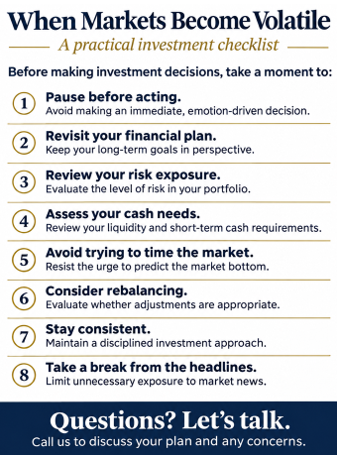
Staying invested does not mean every investor should own the same portfolio or maintain the same level of equity exposure regardless of circumstances.
A portfolio appropriate for someone in their 30s may often be entirely inappropriate for someone approaching retirement who expects to begin taking substantial distributions.
Investment strategies should reflect several important considerations:
Time horizon: When will the money be needed? Funds intended for long-term objectives may be invested differently from funds needed within the next few years.
Risk tolerance: How much volatility can an investor financially and emotionally withstand? An investment strategy that causes an investor to lose sleep or make repeated emotional decisions may not be appropriate.
Income requirements: Retirees and individuals approaching retirement should understand how market declines could affect their ability to generate sustainable income.
Liquidity needs: Investors should maintain sufficient accessible resources to address emergencies and anticipated expenses without being forced to sell long-term investments during unfavorable market conditions.
Diversification: Spreading investments across different asset classes, sectors, industries, and geographic markets can help reduce concentration risk. Diversification does not eliminate market risk or guarantee against losses, but it can help create a more balanced investment approach.
The most effective investment strategy is not necessarily the one that produces the highest returns during favorable markets. It is one that an investor can realistically maintain through both favorable and unfavorable market environments.
Volatility Can Create Opportunities
Although market declines can be uncomfortable, they may also create opportunities for investors who have a long-term perspective and an appropriate financial plan.
Lower market valuations can provide opportunities to purchase investments at more attractive prices. Investors making regular contributions may acquire additional shares when prices decline.
Similarly, disciplined portfolio rebalancing can help investors maintain their intended asset allocation. When one portion of a portfolio declines more than another, rebalancing may involve purchasing investments that have fallen below their target allocation and reducing positions that have become overweight.
However, these decisions should be made within the context of an established investment strategy, not simply because the market has declined.
Investors should also recognize that not every declining investment represents an opportunity. Individual companies, industries, and investment strategies can experience permanent changes in their underlying fundamentals.
The objective is to distinguish between broad market volatility and a fundamental deterioration in a particular investment.
This is where ongoing portfolio monitoring and professional guidance can be particularly valuable.
Our Role During Volatility Times
Periods of market volatility provide us with an important opportunity to demonstrate our value beyond investment selection and portfolio management.
One of the most valuable roles we play during a market downturn is not about predicting what the market will do tomorrow. It is about positioning your overall financial strategy appropriately for your situation.
We believe in proactive communication, and your financial well-being always remains our top priority. Ultimately, successful financial planning is not about eliminating uncertainty. It is about helping you make informed decisions despite uncertainty.
The Bottom Line: Discipline is a Competitive Advantage
Market volatility is inevitable. Emotional investing, however, is a choice.
Investors who understand their objectives, maintain appropriate diversification, establish realistic expectations, and follow a disciplined investment strategy are generally better positioned to navigate periods of uncertainty. There will always be reasons to worry about the markets. There will also be reasons to feel optimistic. The challenge is not allowing every new development to dictate a change in investment strategy.
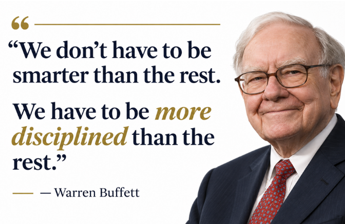
Long-term investing requires patience, perspective, and the ability to remain disciplined when doing so becomes uncomfortable. The most successful investors are not necessarily those who predict every market movement correctly. They are often those who establish a sound plan, understand the risks, maintain realistic expectations, and resist the temptation to abandon their strategy when markets become uncomfortable.
We believe an informed client is the best client. Our commitment is to offer our clients consistent, meaningful communication and to proactively help them navigate the changing economic environment. As always, we appreciate the opportunity to assist you with all your financial needs. If you have any questions during your journey, please feel free to connect with us.
Complimentary Financial Consultation
We believe informed decisions lead to better financial outcomes, and we'd be honored to help you evaluate your current plan. If you're not currently a client of Financial Advisors Network, Inc., we'd be pleased to offer you a complimentary one-hour financial check-up at no cost and with absolutely no obligation.
To learn more or schedule your complimentary consultation, call (714) 597-6510.
Upcoming Events
- Tax Planning & Update Webinar | Wed, Jan 13 at 6pm PT
- Retirement Classes | Wed/Thu/Sat in Irvine, Mission Viejo & Huntington Beach
- Investments Webinar | Wed, Feb 10 at 6pm PT
- Property Inheritance Webinar | Wed, Feb 17 at 6pm PT
- Social Security & Medicare Webinar | Wed, Feb 24 at 6pm PT
Click HERE to learn more about our upcoming events.
Financial Advisors Network, Inc. is a registered investment advisory firm. Note: The views stated in this letter are not necessarily the opinion of Financial Advisors Network, Inc., and should not be construed, directly or indirectly, as an offer to buy or sell any securities mentioned herein. Investors should be aware that there are risks inherent in all investments, such as fluctuations in investment principle. With any investment vehicle, past performance is not a guarantee of future results. Material discussed herewith is meant for general illustration and/or informational purposes only, please note that individual situations can vary. Therefore, the information should be relied upon when coordinated with individual professional advice. This material contains forward-looking statements and projections. There are no guarantees that these results will be achieved. There is no guarantee that a diversified portfolio will enhance overall returns and outperform a non-diversified portfolio. Diversification does not protect against market risk. Contents provided by the Academy of Preferred Financial Advisors, 2026
Turn Bulletins into Action
Stay informed—then come in for a free consultation and see how the updates apply to your financial life.